If you’re looking for a cabin with a hot tub in Sussex, most places follow the same pattern — a row of cabins, a standard electric tub, and a setup designed for convenience rather than experience. And for some stays, that works perfectly well.
But every now and then, you come across something that’s been built differently from the ground up.
Not Just a Hot Tub Beside the Cabin — A Space of Its Own
It’s been built as its own space, a place to stay and relax, whether you are in the tub or not.
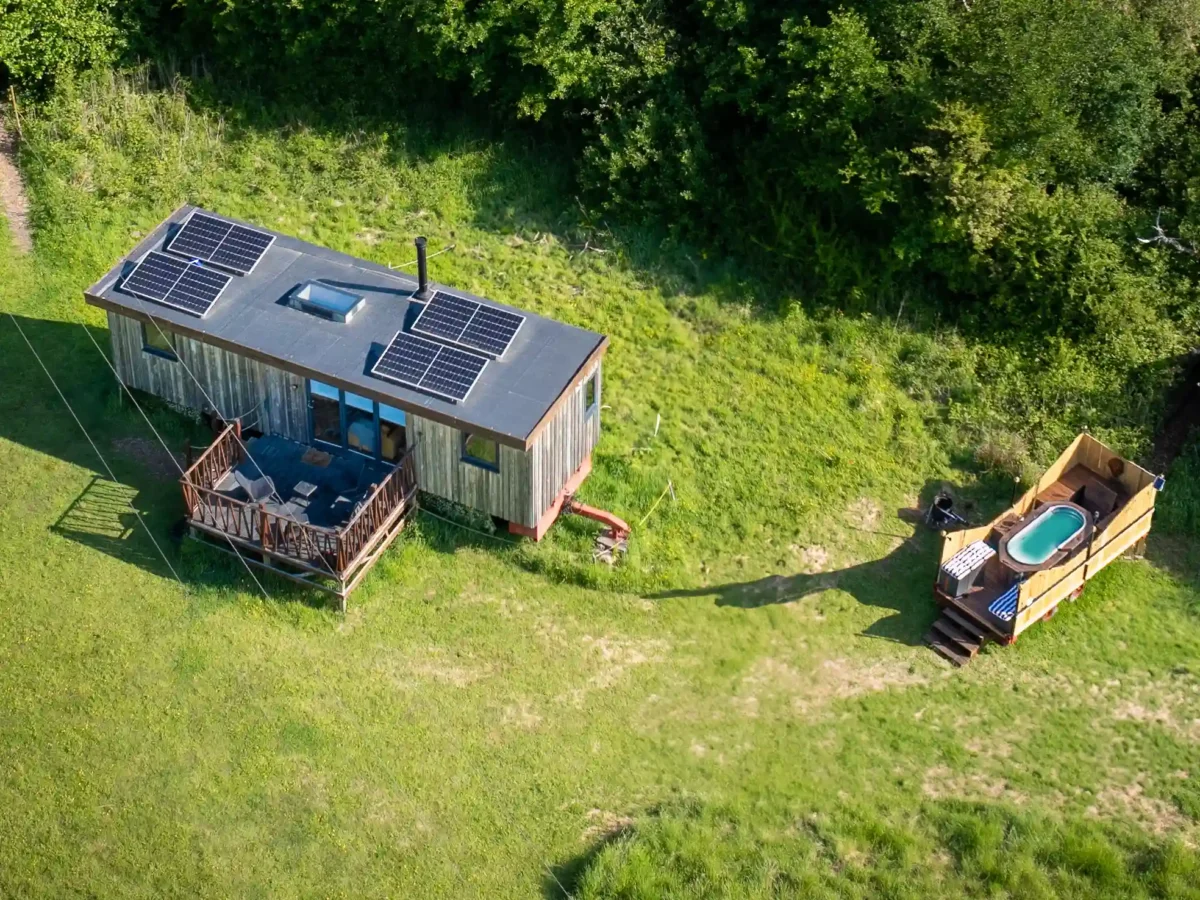
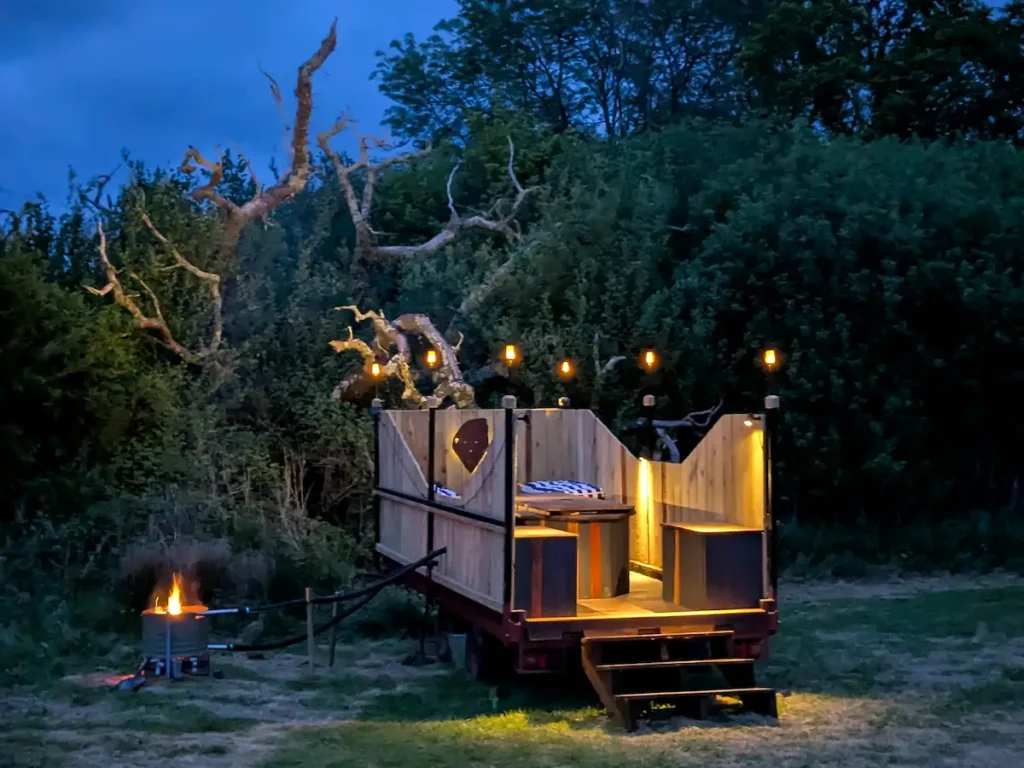
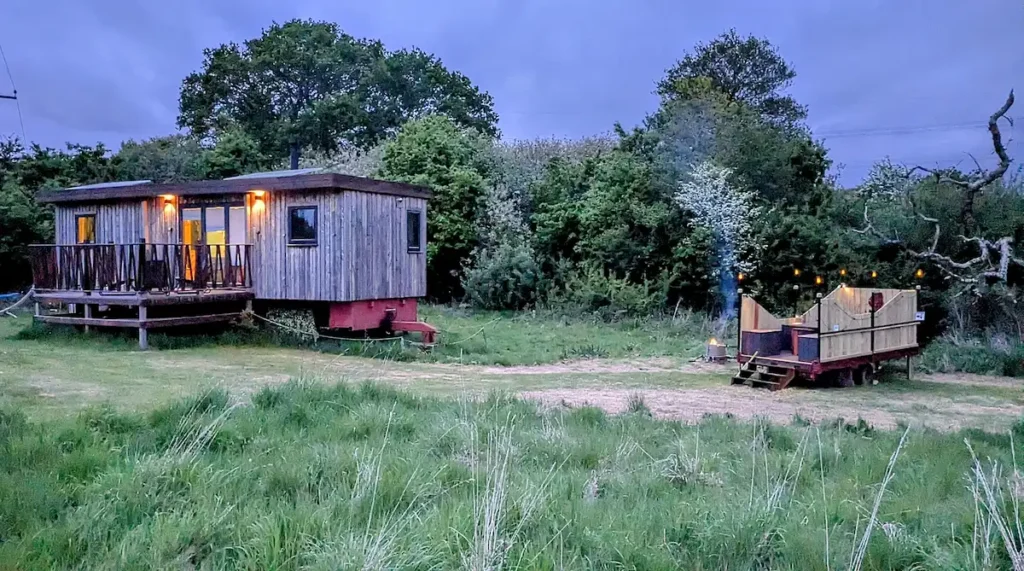
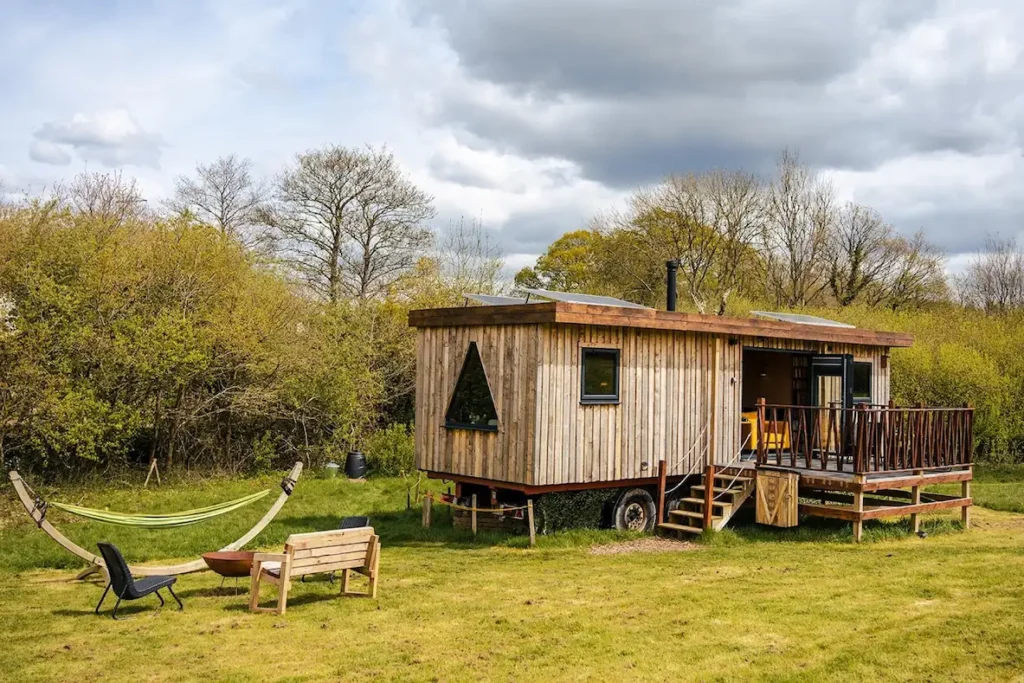
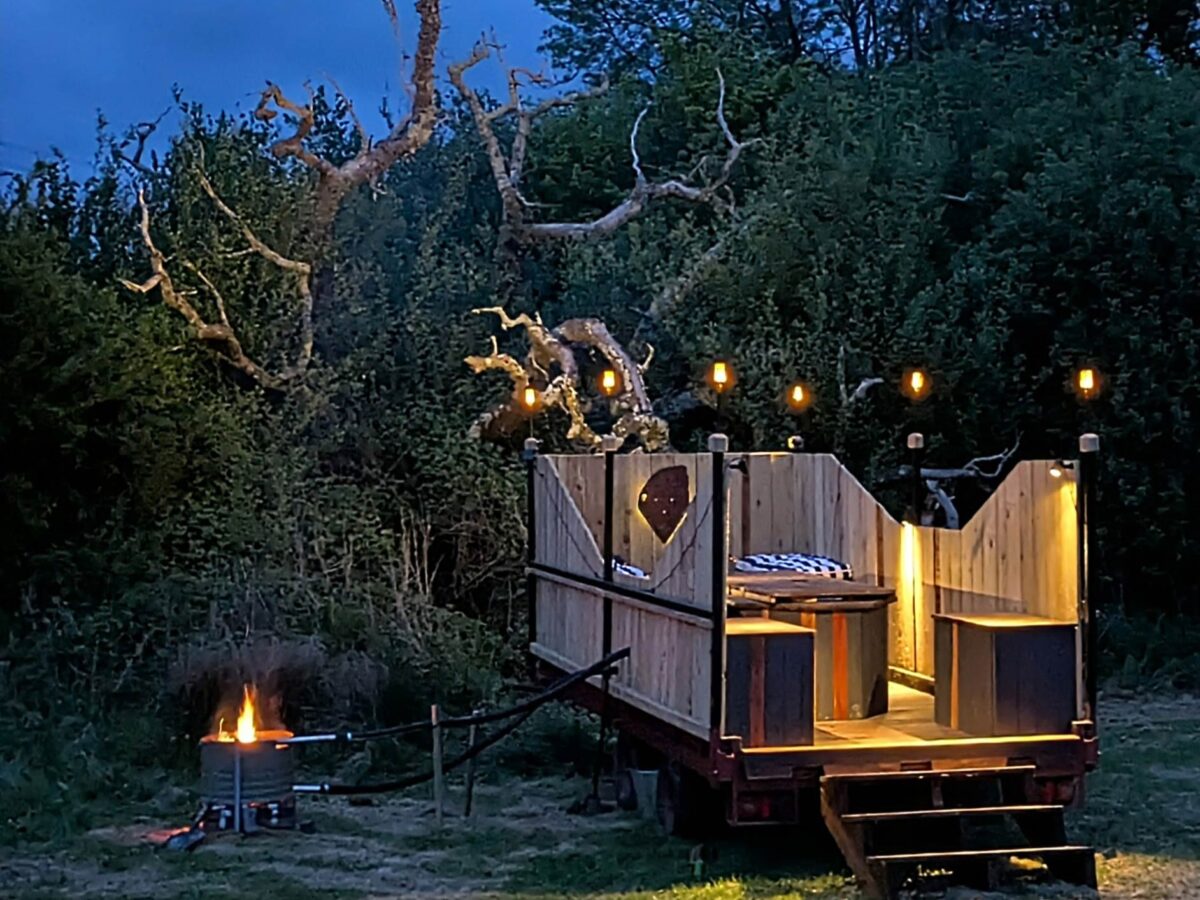
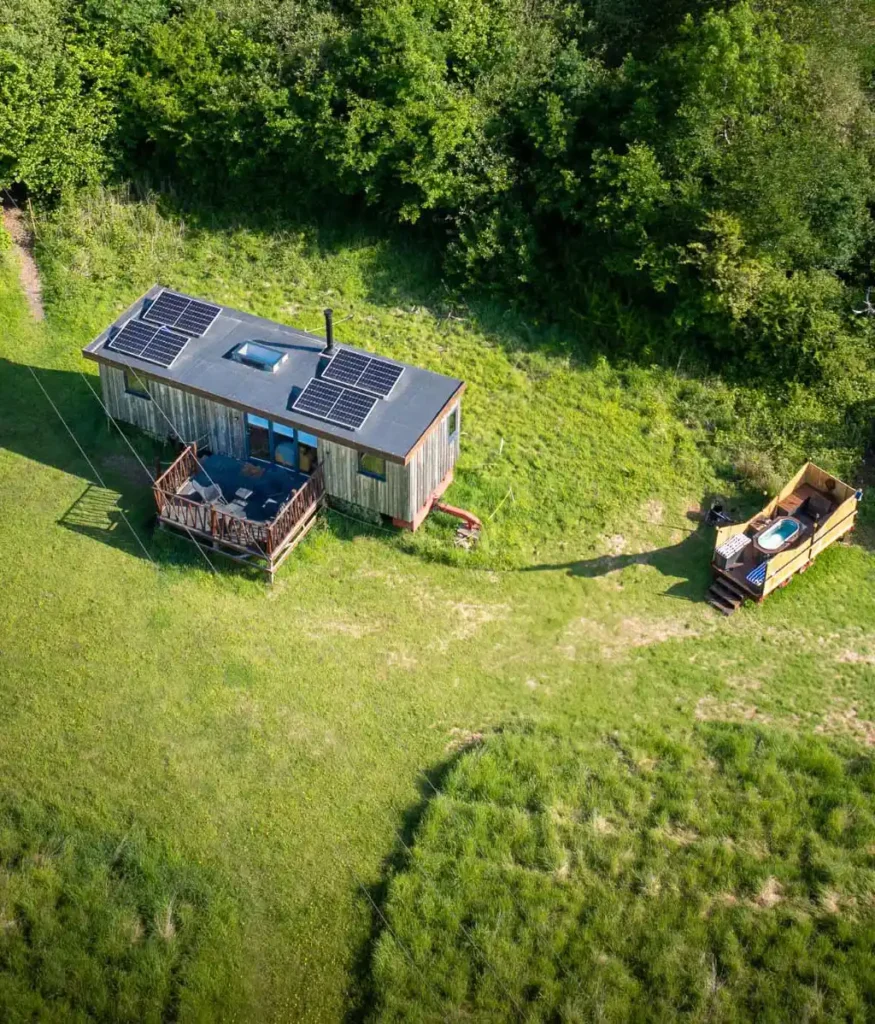
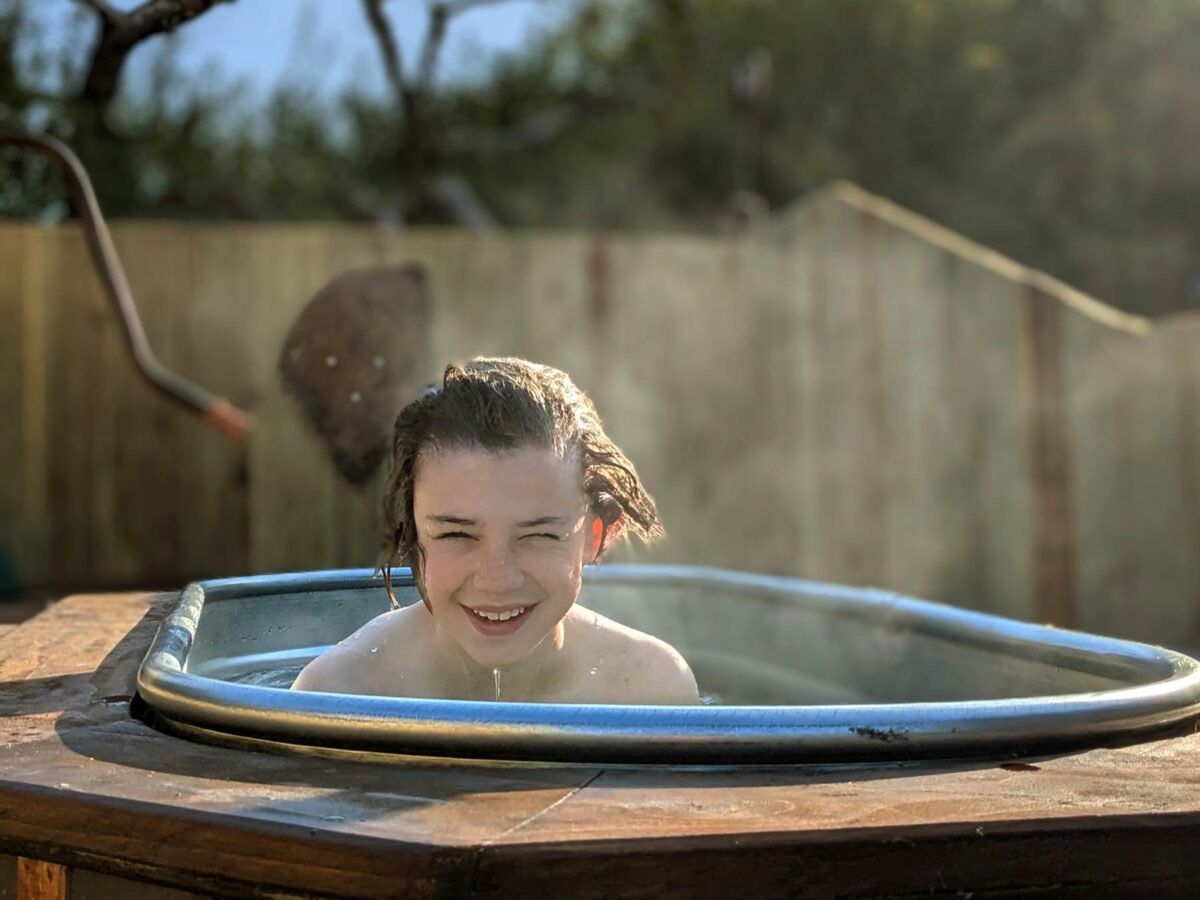
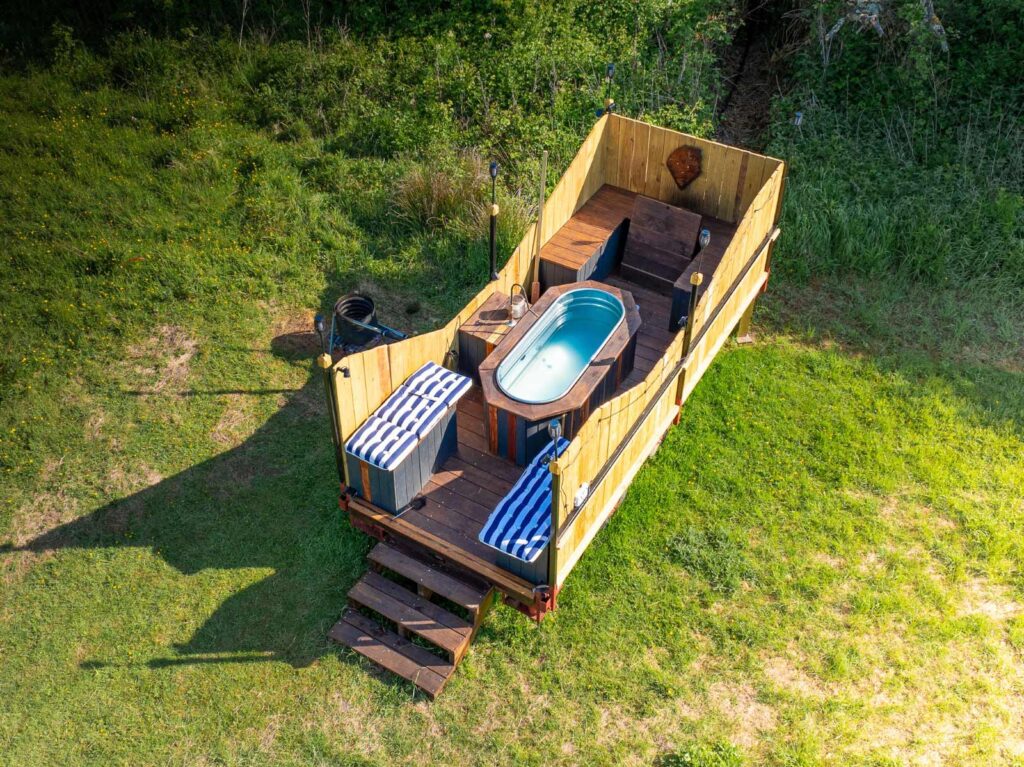
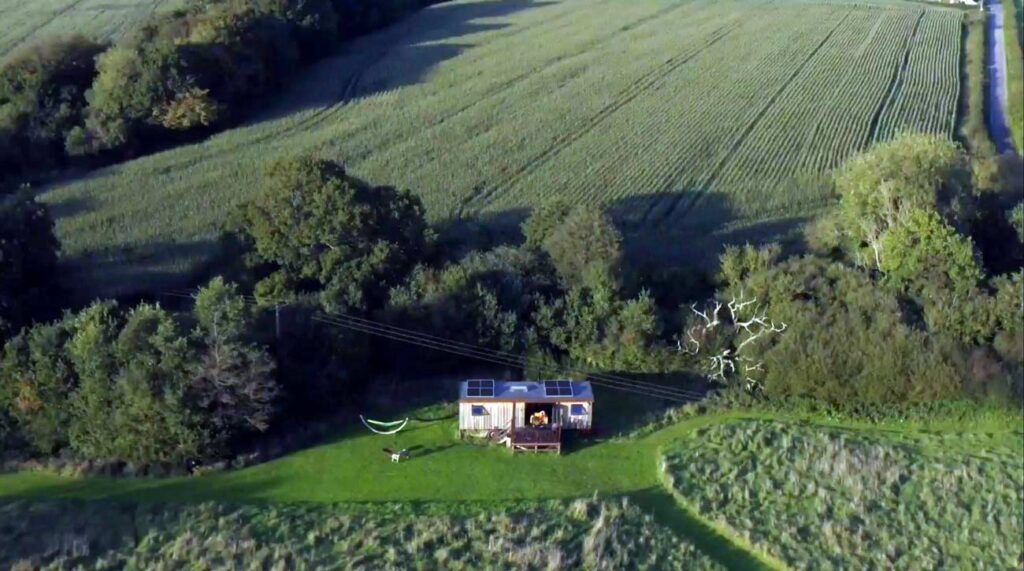
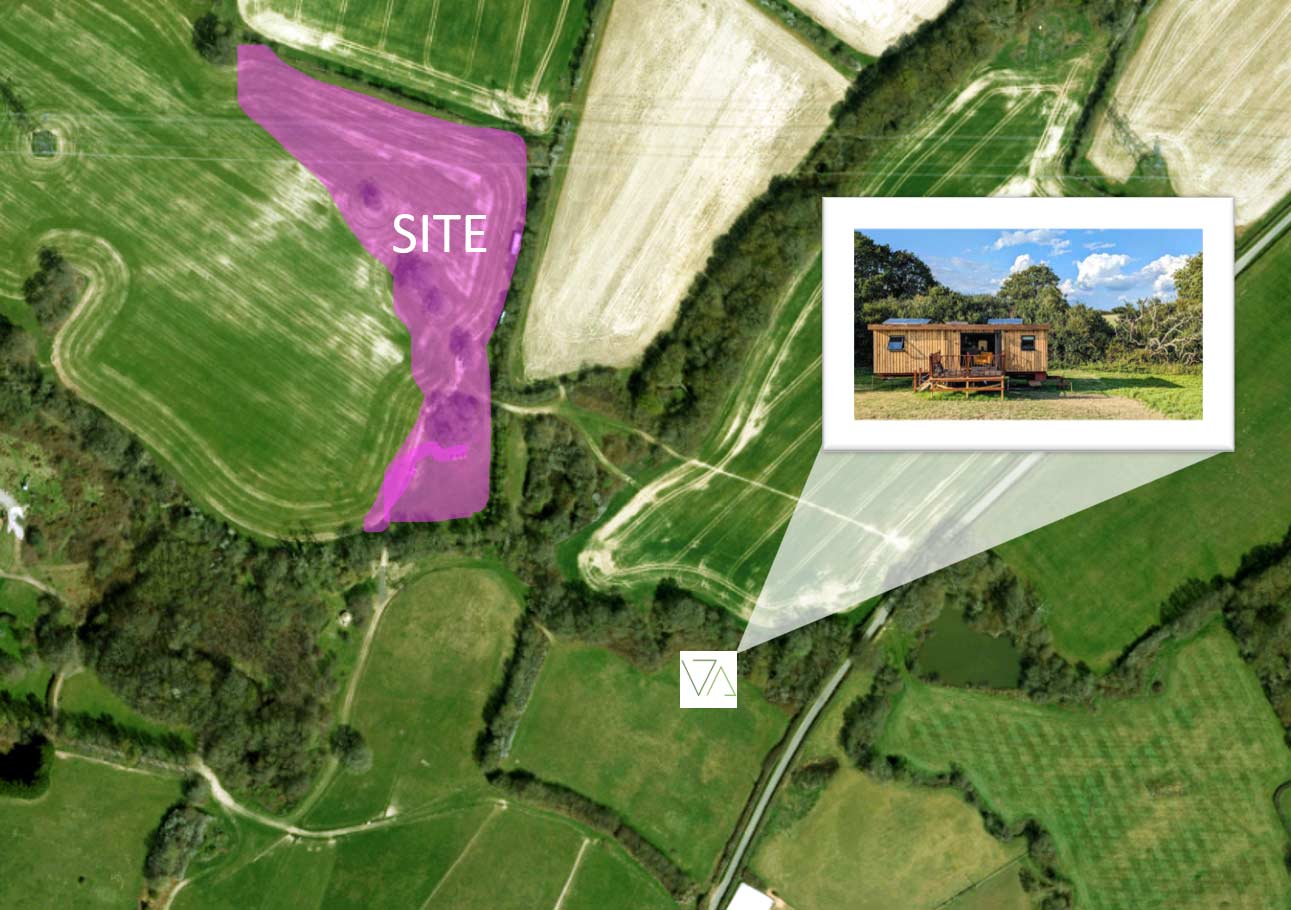
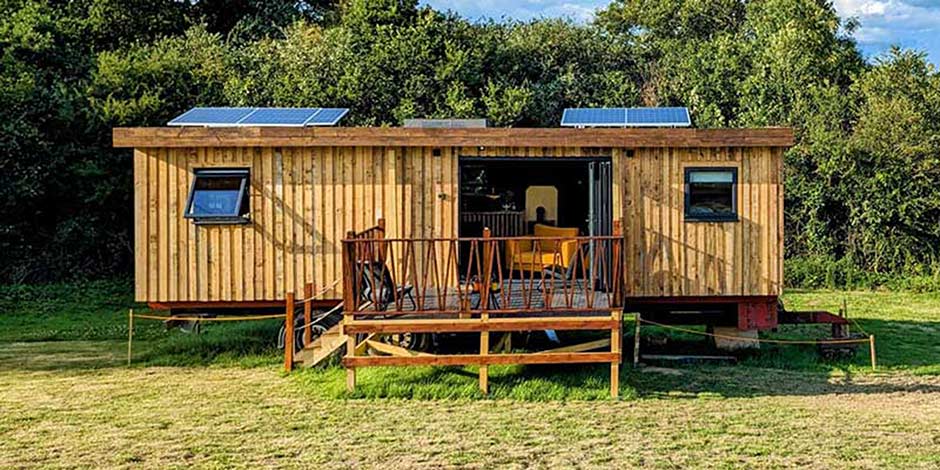
Set on a repurposed trailer and raised slightly off the ground, it feels less like walking over to a tub and more like stepping into a separate outdoor space — somewhere to sit, relax, and spend time, not just dip in and out.
What Makes This Wood-Fired Hot Tub Different?
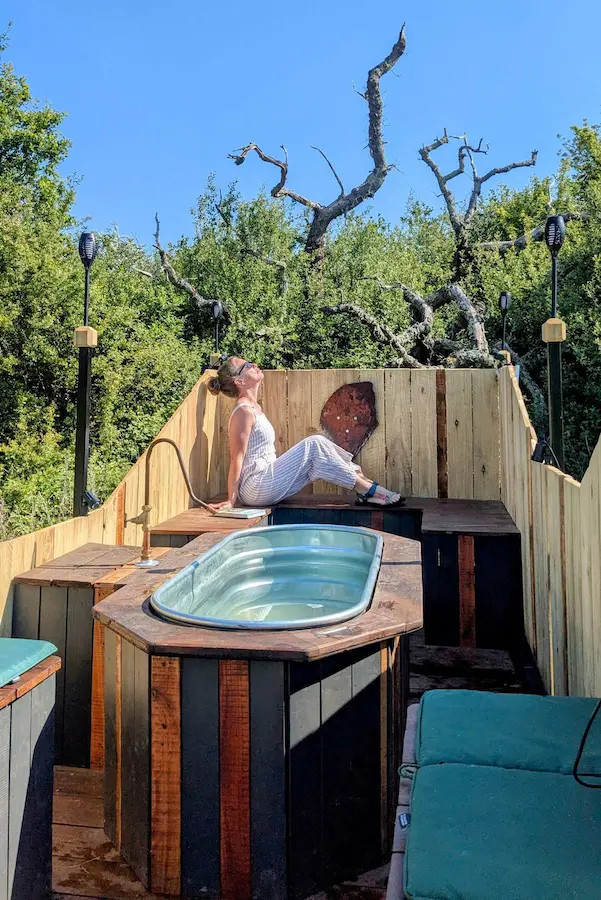
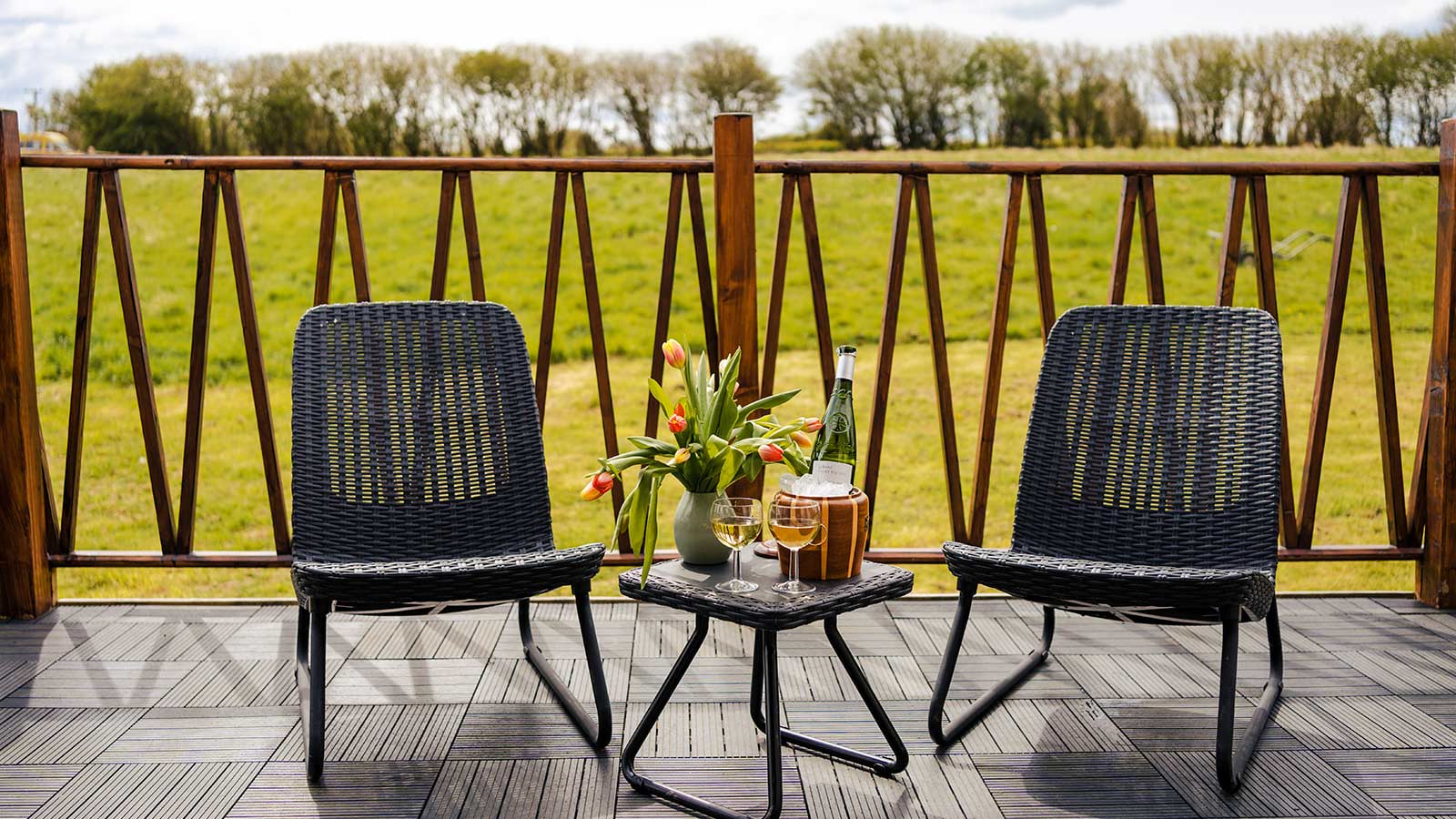
This isn’t just a hot tub placed beside a cabin. The tub sits on a raised trailer deck, with seating around it and open countryside beyond. It feels more like a small outdoor space than a simple add-on.
Because it is wood-fired, the experience is slower and more hands-on. You light the fire, let the water heat gradually, and settle into the space as the evening changes around you. That slower rhythm is part of the appeal, especially if you are looking for a cabin stay that feels private, quiet and a bit different.
It’s wood-fired, which changes everything. There’s no switch to flick: you light the fire, let it build, and give it time.
The water heats slowly, the light fades. The space around you becomes quieter. By the time you step in, it feels very different to a typical hot tub experience. There’s no hum of pumps, no background noise, just the crackle of fire and whatever’s happening in the field around you.
It’s slower, more hands-on, and a big part of why the whole setup feels so different from a standard hot tub stay.
We’re Close to London, But It Doesn’t Feel Like It
One of the surprising things is how easy it is to get here. Just over an hour from London — but once you’re here, it doesn’t feel like it at all.
There are no people passing through, just open Sussex countryside all around you and space to properly switch off.
If You’re Looking for Something a Bit Different
There’s nothing wrong with the usual version of a cabin with a hot tub. But if you’re after something quieter, more private, and a bit more considered, it’s worth looking a little closer at what’s actually on offer. Because sometimes the difference isn’t just where you stay — it’s how it’s been put together.
If you’re deciding whether a digital detox is right for you — and what kind actually works — this page will help you understand the difference.
If you’ve looked for a digital detox cabin in the UK recently, you’ll know the landscape is pretty crowded. A lot of the options look the same: minimalist prefab cubes, one big window, a fold-out bed, a lock box for your phone as part of the “experience,” and a heavy lean on tech workers escaping burnout.
Nothing wrong with that — it’s just become the mould. We’re pleased we offer something different.
While the digital detox trend has surged, our off-grid cabin stay in Sussex retreat has quietly taken a different path. The Vacationist Eco-Cabin wasn’t built to follow the “tiny detox pod” formula. It wasn’t designed as a tech company’s answer to stress. It wasn’t sketched on an investor pitch deck.
It’s a real cabin. In a real field. With real space, real firelight, real peace, and character. And that difference matters more than one might think
Most people aren’t looking for a gimmick. They’re looking for breathing room — time without notifications, noise, or the endless mental sprint of being reachable 24/7. The appetite for slow, grounded, nature-led escapes has never been higher.
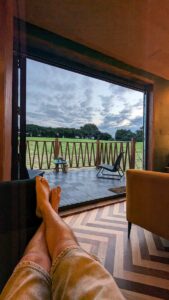
Cabin, sun-deck, field, hot-tub, hammock, fire-pits, woodland chill out area…. detox where you like!
Why Some Digital Detox Cabins Get It Wrong
Plenty of digital detox cabins in the UK sound peaceful on paper, but look closer and you often get:
tiny, boxy units
shared sites with multiple cabins
spaces designed more for photos as for peace and comfort
an experience that feels curated, not natural
They’re fine for people who want a quick break from emails — but they don’t offer the deep exhale many guests truly need.
A proper digital detox isn’t just removing WiFi. It’s designing a whole environment that makes switching off feel effortless.
How This Sussex Cabin Leads a Different (Re)Charge
The Vacationist Eco-Cabin was built with space, comfort and calm in mind — not as a detox product, but as a place that naturally helps people switch off.
Rather than enforcing phone-free rules or designing around restriction, the environment itself does the work.
A Screen-Free Holiday in a UK Log Cabin That Actually Feels Good
A lot of screen-free stays in the UK are built around restriction — lockboxes, rules, and the idea that switching off has to feel hard to be effective.
At The Vacationist, the approach is different. The space itself encourages you to slow down, without enforcing behaviour or removing choice. When your surroundings are calm, warm and comfortable, reaching for your phone simply starts to feel less appealing.
Walk, explore, forage! Nature makes good work for idle hands.
The Best Digital Detox Cabin Near London — Without Being a Tiny Pod
This isn’t deep Scotland or remote Wales. It’s just over an hour from London, but feels like a completely different world.
That’s why it works so well for:
stressed professionals
people craving stillness
parents needing real downtime
couples wanting reconnection
anyone whose brain feels like a browser with 47 tabs open
You’re far enough from the city to breathe, but close enough that travelling doesn’t feel like work.
Kids need quality time away from screens too. And done right, they love it!
Why Guests Say This Cabin Works so well
The Vacationist wasn’t created as part of the digital detox “industry”.
It was created because we built a space we ourselves wanted — one that feels calming and comfortable without trying too hard. The ‘digital detox’ effect is a natural byproduct of the environment, not a marketing tactic.
That’s why guests switch off more easily:
“Where to start….honestly one of the best glamping breaks we’ve been on, and we’ve been on a fair few! This place was just magical. Each and every eco and design detail on the cabin were noted and very much enjoyed. The space was well thought through and the little touches like tea, coffee, shampoo etc much appreciated. Beds and seating areas super comfy. Then on to the outside space – a veranda directly outside, perfect for morning coffee in the sunshine, the fire pit in the open field perfect for the last of the sunshine and the secret wooded area, perfect for sheltering from the rain – or extreme heat if you’re lucky. And the whole space just for us, pure bliss. From the point of booking, to the lead up, our stay and after, Guy was the perfect host. Thanks so much for giving our family a little taste of the slower life, we will be back for more.”
-Suzanne, June ’24 (GOOGLE REVIEW)
Who This Kind of Digital Detox Suits Best
This type of digital detox isn’t about extremes or strict rules. It tends to work best for people who want space, calm and a genuine change of pace — without feeling constrained.
It’s particularly well suited to couples looking to reconnect without distraction, solo guests needing headspace, and families who want a gentler break from screens that doesn’t feel forced.
You don’t need to be burnt out to benefit. Often, it’s simply about stepping away from constant noise and giving yourself room to slow down — comfortably and on your own terms.
Our is a digital-detox cabin retreat with actual style. Not much is pared back here!
A Gentler Approach to Digital Detox
Digital detox doesn’t have to mean rules, restriction or extreme disconnection. For many people, it works best when it’s woven naturally into a comfortable, calming environment — one that makes slowing down feel easy rather than enforced.
If you’re curious about what a digital detox at The Vacationist is actually like — and whether it might suit you — you can explore the full experience here:
When couples search for a private cabin retreat in Sussex, they’re usually looking for something quieter, simpler and more grounded than a standard getaway. East Sussex is one of the few places where you can still get a sense of space — wide open fields, woodland edges, proper dark skies and slow evenings that feel removed from everyday noise.
Put that together with a secluded eco-cabin and a private wood-fired hot tub, and the whole atmosphere shifts into something memorable. It becomes less of a “break” and more of a reset.
And if you’re looking for a private cabin with a wood-fired hot tub, you’ll find that this kind of setup changes everything — especially when it sits in its own field, heated by real flame and completely yours for the night. You can explore the full hot tub experience here.
What an Off-Grid Escape Usually Means for Couples
When people book an off-grid stay, they’re usually after a certain feeling rather than a checklist. It’s about stepping into a place that lets things slow down — somewhere with space, stillness and a bit of nature wrapped around you.
Privacy that feels genuine
A cabin that stands on its own. A field that opens out in front of you. No one passing by, no noise from neighbours — just the freedom to settle in without thinking about who’s around.
It’s often the small things that make the difference: birds moving across the tree line, the sound of the wind in the grass, the sky gradually changing colour. Nothing staged — just the countryside doing what it does.
Evenings that unfold rather than rush
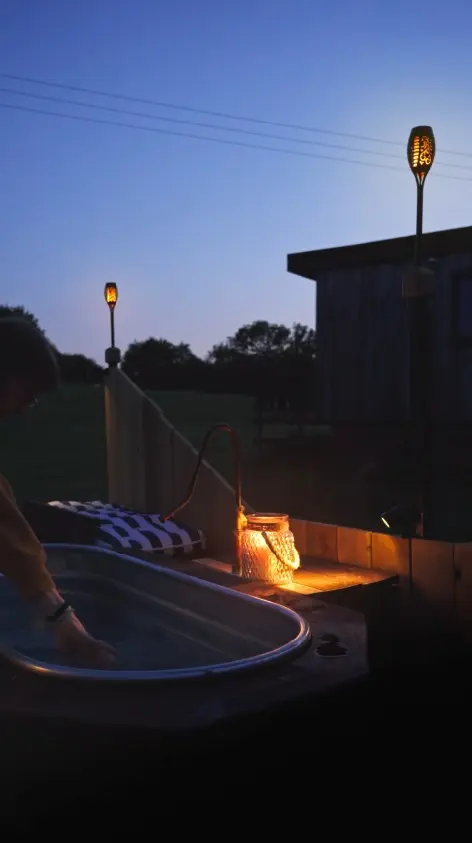
Most couples aren’t looking to fill an itinerary. They want evenings that evolve on their own: a drink outside, the warmth of the tub building, lanterns coming on, the sky deepening. No deadlines. No buzz. Just time stretching a little.
Why Sussex Works So Well for Romantic Glamping
Sussex has a way of feeling rural without being remote. That balance makes it ideal for couples wanting peace without isolation.
Why a Wood-Fired Hot Tub Changes the Entire Atmosphere
Electric hot tubs work in holiday parks, but for a romantic break, a wood-fired tub feels utterly different.
The quiet
No pumps. No motors. Just warm water and open air.
The ritual
Lighting the fire, watching the flames take, and letting the warmth build becomes part of the evening.
The scent of woodsmoke
Soft, atmospheric, and grounding — it mixes with the cool air and rising steam.
Natural heat
The water feels softer and more relaxing compared to a standard electric spa.
It belongs in nature
Timber, lanterns, fire and sky — nothing clashes with the setting.
What an Evening at this romantic cabin in East SussexActually Feels Like
Imagine returning to the cabin after a slow walk or a day exploring Lewes or the countryside. The field is still. The tree line holds the last of the daylight.
You light the fire beneath the hot tub and sit outside while it warms, drink in hand, the quiet settling in around you. As the sky shifts — gold to blue to night — lanterns glow softly around the cabin. Steam rises from the tub. You climb in, and everything slows down another notch.
Simple. Private. Unforced.
This is what romantic off-grid glamping in Sussex feels like when the setting is right.
Why Couples Choose This Over a Standard Hot Tub Lodge
Spa lodges are great for bubbles and jets — but they usually come with:
chlorine smell
machinery noise
neighbouring decks
harsh lighting
shared facilities
crowded parks
A wood-fired hot tub in a quiet field offers something different: lantern light, open air, fire, quiet and space.
Plan Your Romantic Off-Grid Stay
If you’re ready for a weekend that feels calm and unhurried, The Vacationist Eco-Cabin is set up exactly for that: a private field, a fire-lit hot tub, a warm cabin and nature all around you.
Whether it’s a celebration, a first trip in a while, or simply time to step out of the noise, this is the kind of stay that lingers long after you’ve left.
Ready for a Proper Off-Grid Break?
Stay at The Vacationist Eco-Cabin in East Sussex — a private field, a handcrafted cabin, and your own wood-fired hot tub under open skies.
Looking for the perfect spot for family glamping East Sussex?The Vacationist Eco-Cabin in Halland offers a one-of-a-kind escape designed for families who want to reconnect away from screens and routines.
Hidden in its own meadow, this hand-built eco-cabin in Sussex combines sustainable design, cosy off-grid comfort, and playful touches like a secret bunk bedroom and private wood-fired hot tub. It’s a family-friendly retreat where adventure, relaxation, and unforgettable memories come together.
Where Style Meets Story
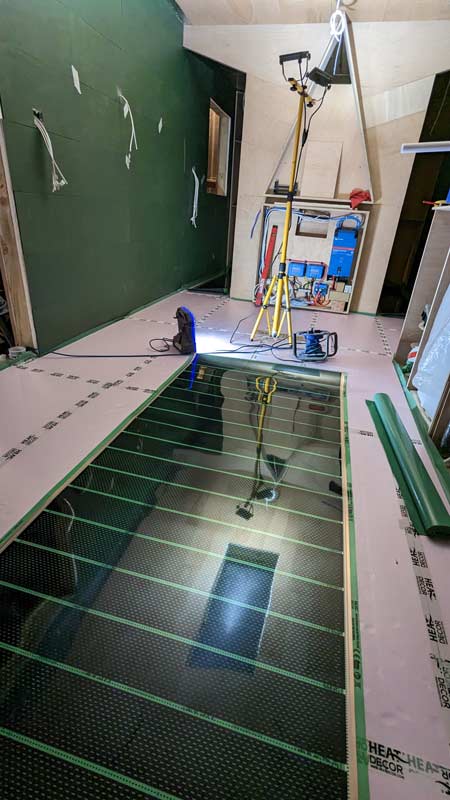
Lovingly crafted from mixed timber, salvaged pallet wood, and authentic local touches, this off-grid retreat doesn’t just look good—it lives its values. Sustainability is stitched into every corner, from the use of sheep’s‑wool insulation and infrared underfloor heating powered by solar energy, to the clean-burning log stove that adds a glow to the evenings.
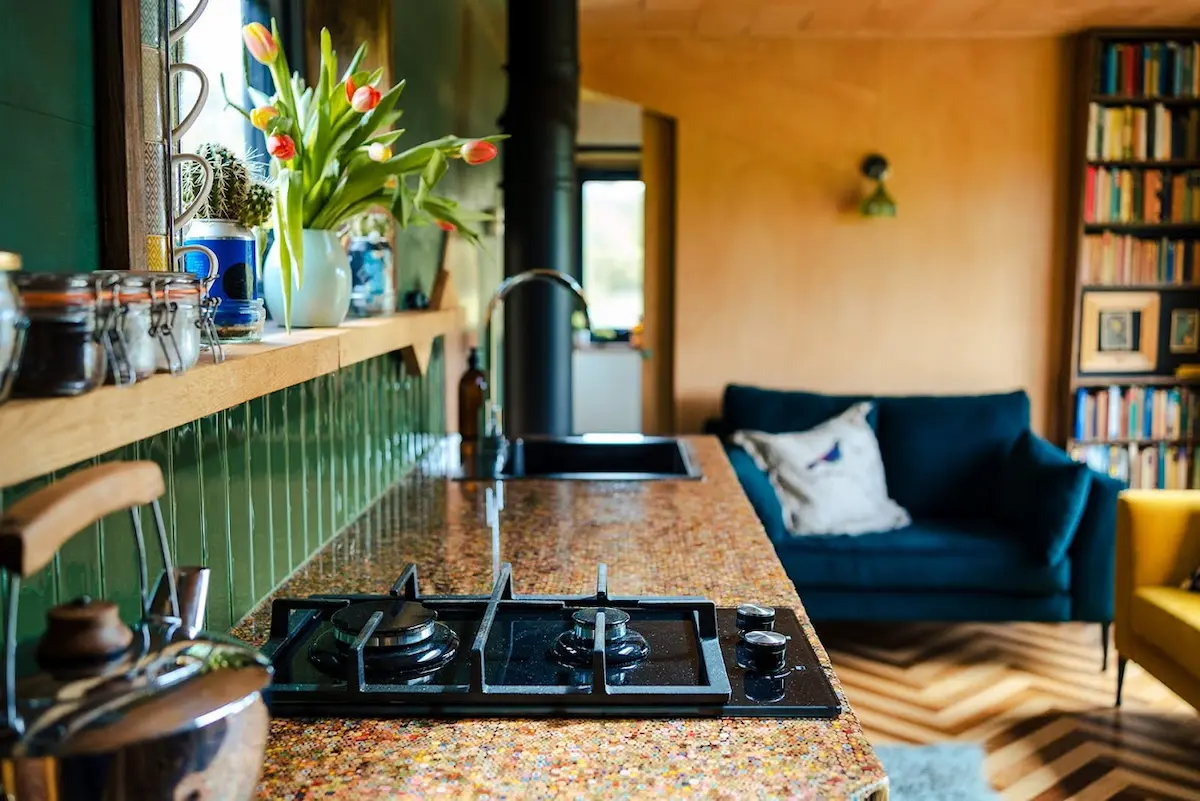
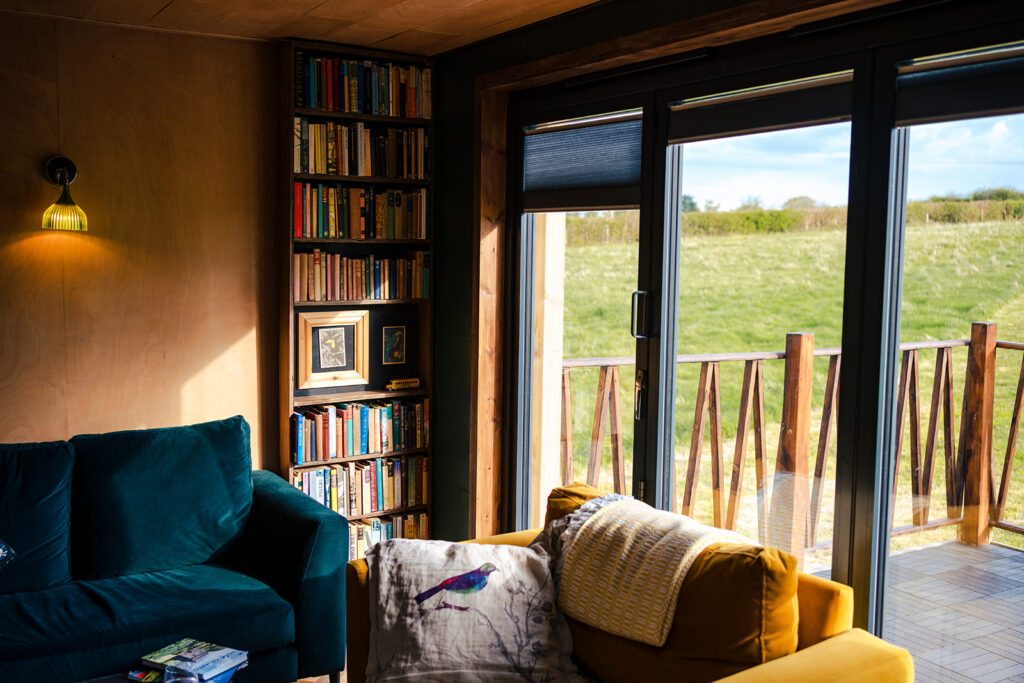
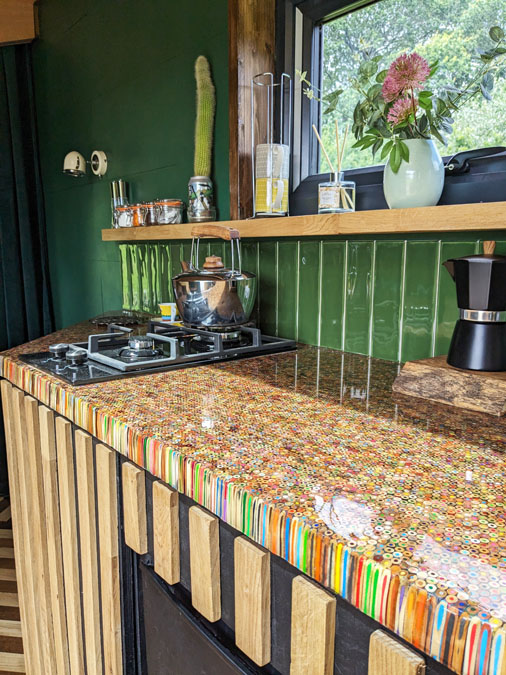
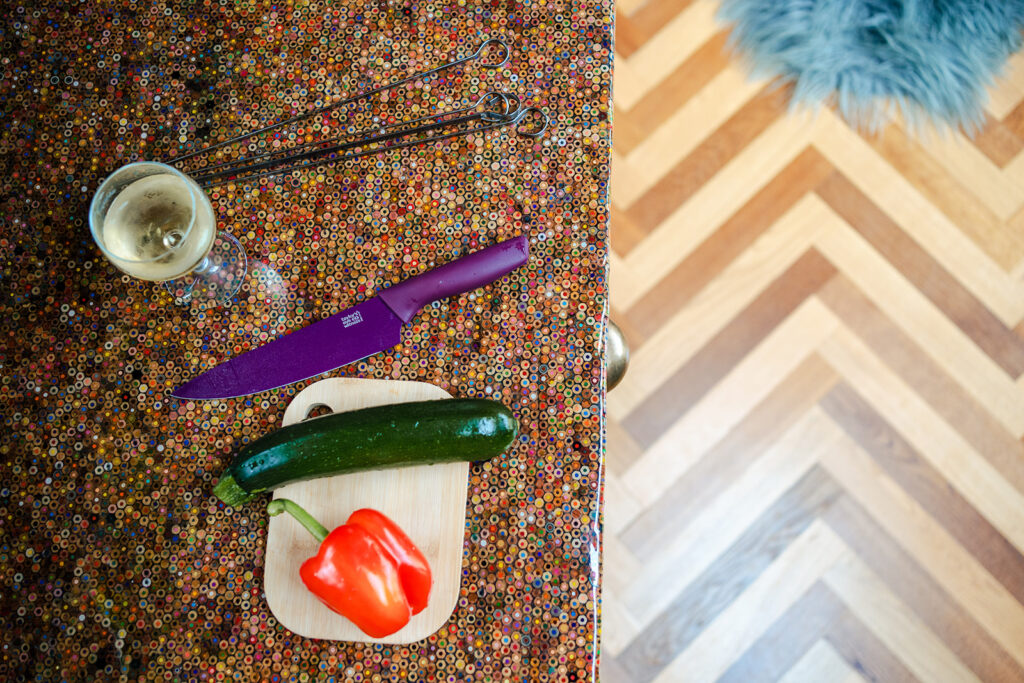
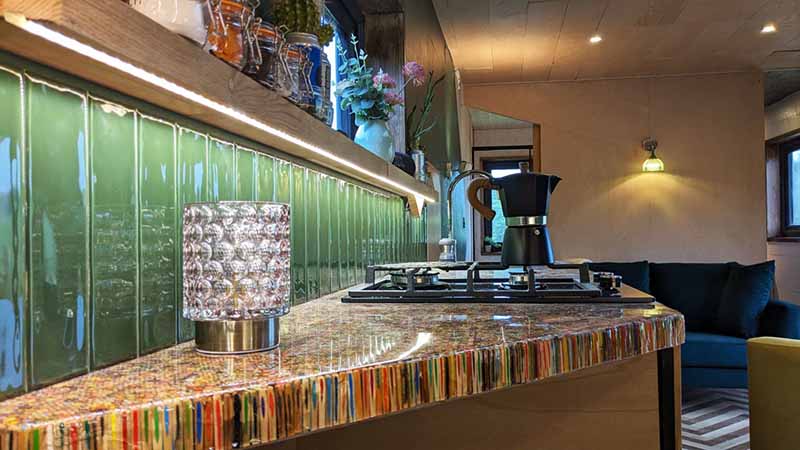
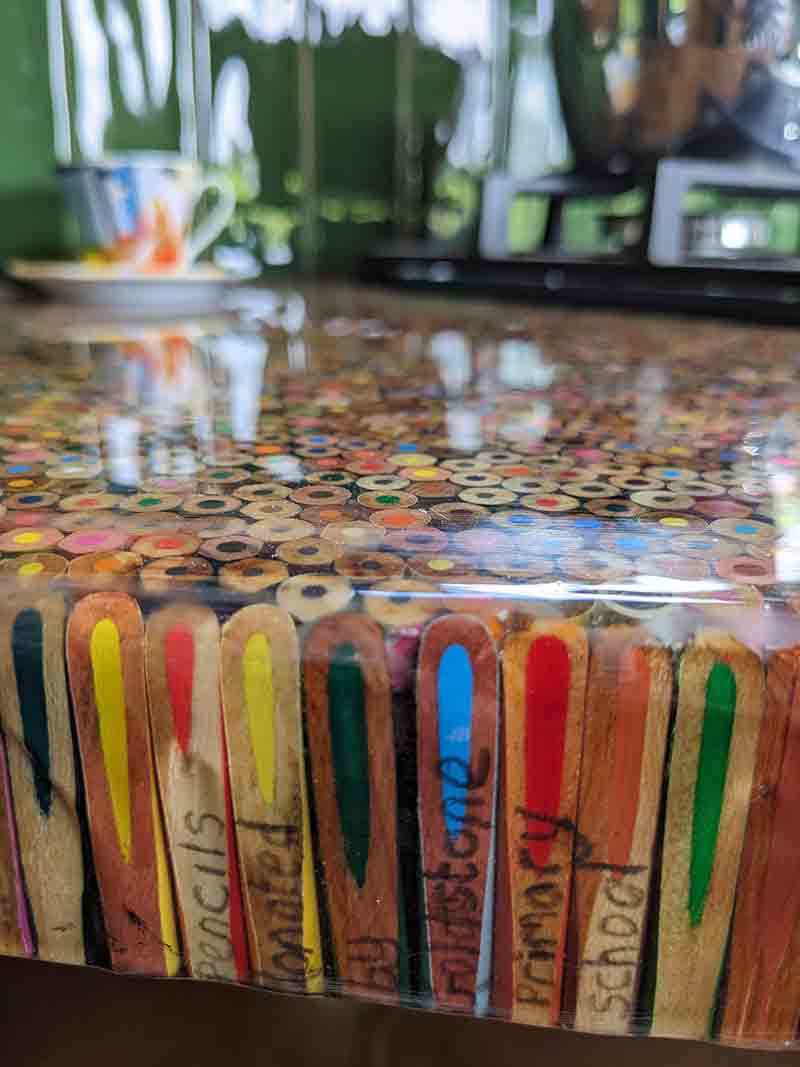
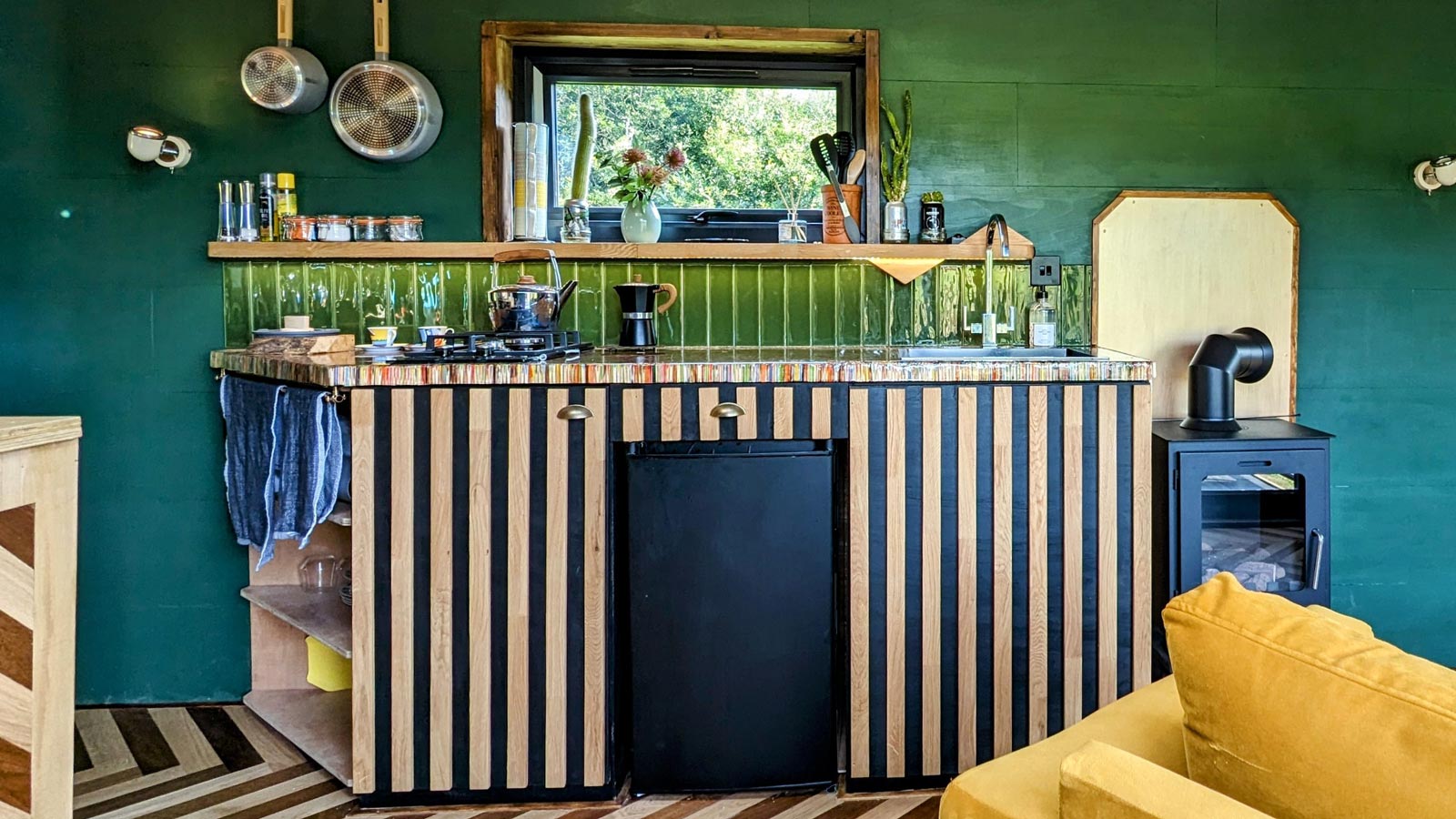
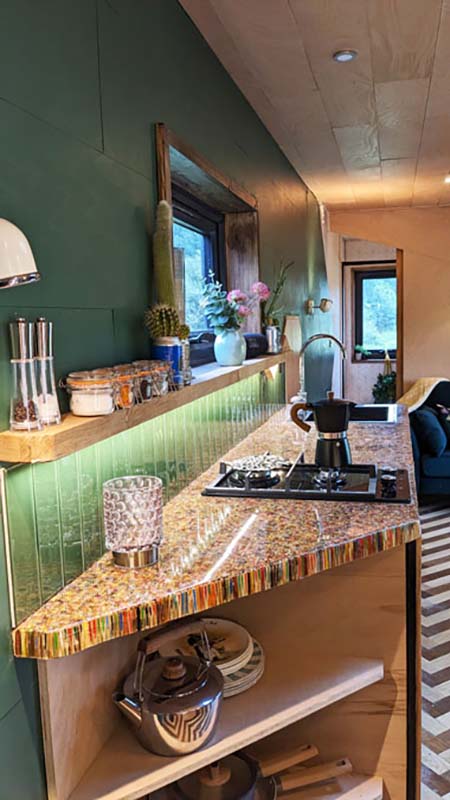
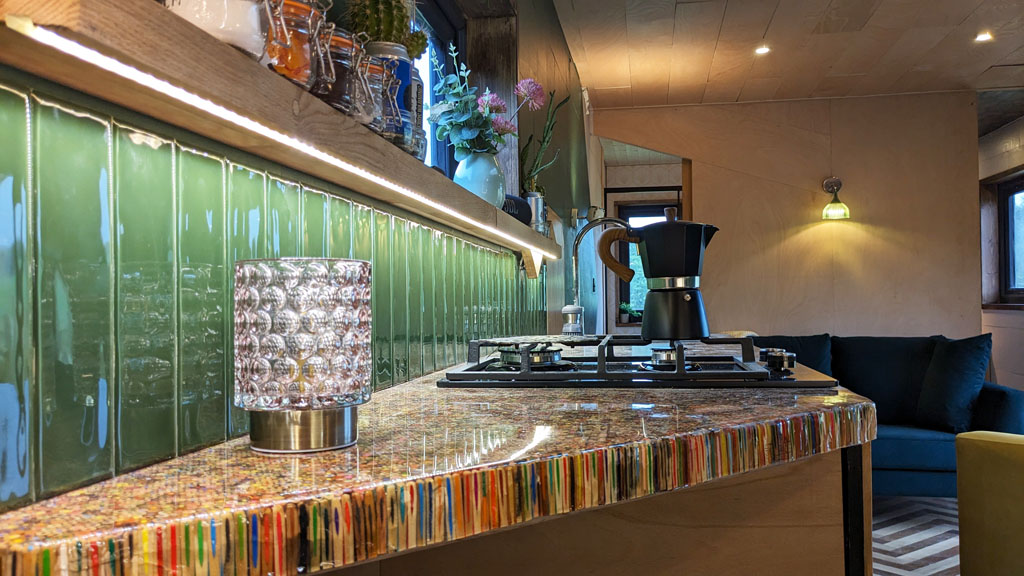
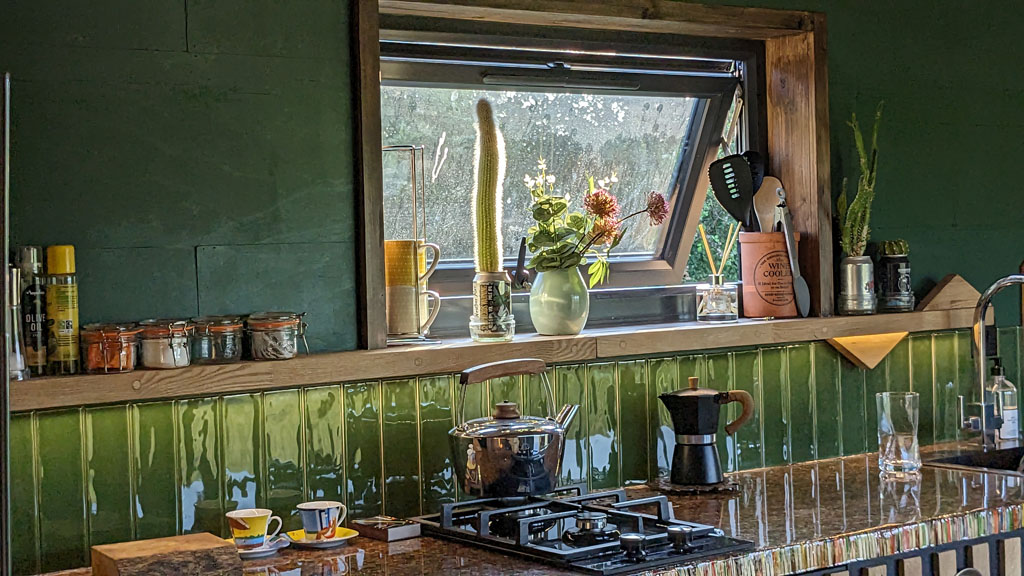
Even the kitchen tells a story. The colourful epoxy worktop, made from donated pencils in collaboration with the local school, is a playful, heartfelt detail that sparks conversation with every meal. The warm timber interior is both calming and characterful, designed to feel like a place with soul—where children’s can enjoy the cosy private den of their ‘secret’ bedroom and adults can stop and relax properly.
This is no ordinary getaway—it’s a space where everything has been considered for comfort, whimsy, and wonder.
" We had a great stay at the Vacationist in August! The children absolutely loved the bedroom hidden behind the bookcase and spent a lot of time in the hammock outside. The beds were comfy and the cabin was beautifully presented with everything we needed. Wonderful. "

NICOLA, AUGUST 2024
The Secret Bookcase and a Bedroom Built for Daydreams
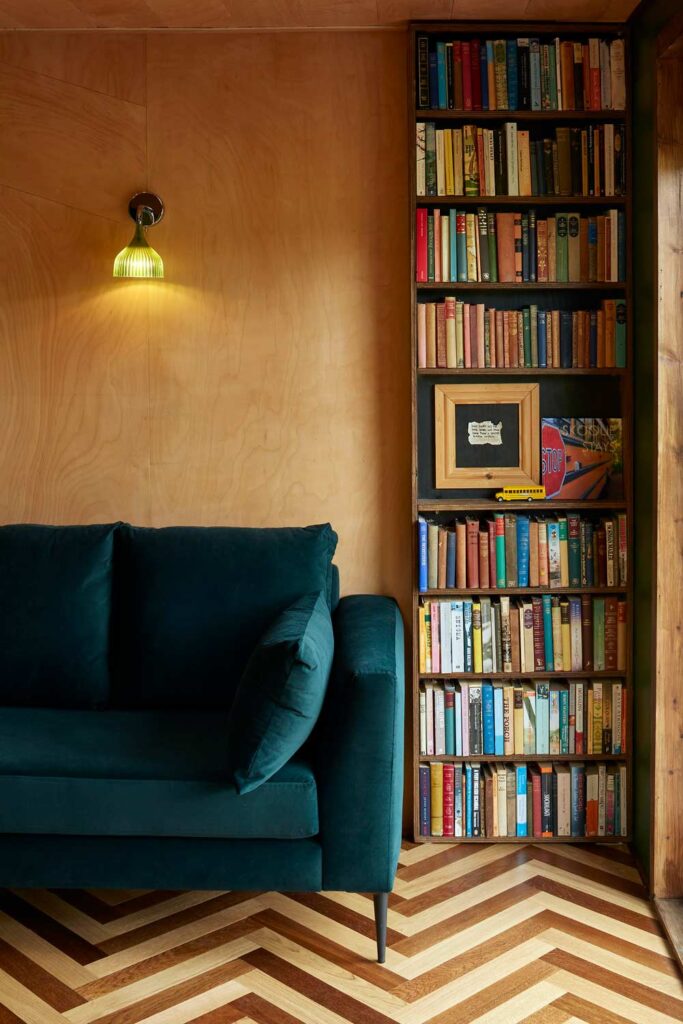
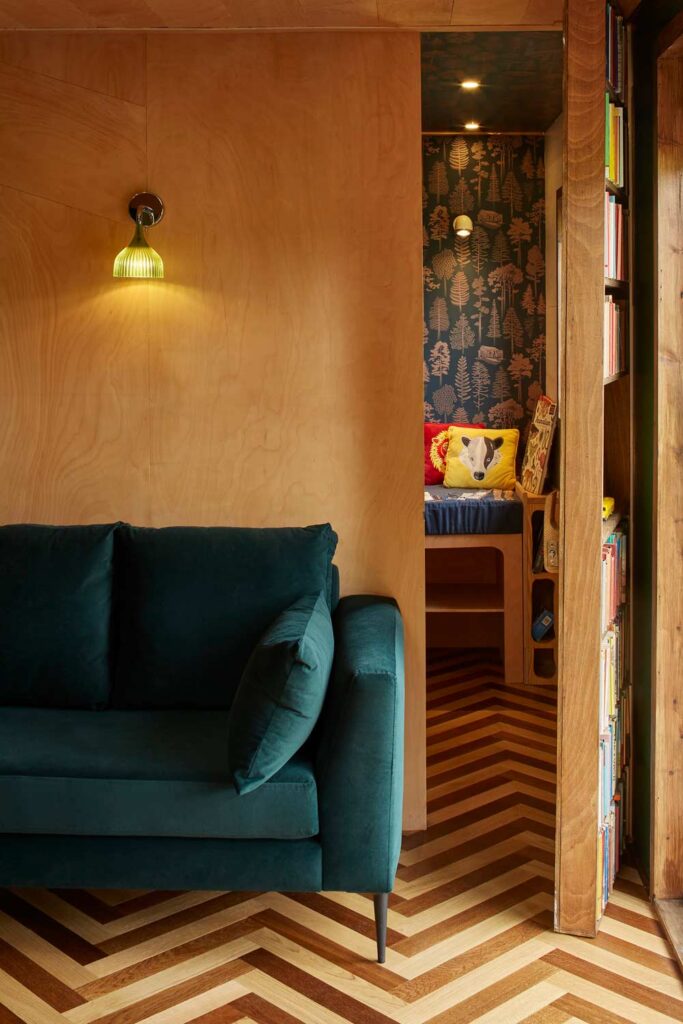
There’s a moment every family remembers here: when the kids discover the hidden bookcase door and what lies behind it. Open it, and you’ll find a secret bunk room—designed especially for younger guests, and lovingly created by the hosts’ own children. Packed with delightful details and crafted to inspire imaginative play, this nook feels like something out of a favourite storybook.
" The cabin is so fun and comfortable with everything you need for a luxury glamping weekend. Our kids had a lot of fun and loved their secret room hidden behind the book case. "

GENEVIEVE, SEPTEMBER 2025
The bunks aren’t just fun—they’re proper beds, suitable for kids or even small adults up to 6ft tall. It’s a den, a hideout, and a memory-maker in one. Meanwhile, the grown-ups sleep easy on the king-size bed, with views out onto the wildflower meadow and the gentle sounds of nature at night.
A Hot Tub on Wheels & Marshmallows by Firelight
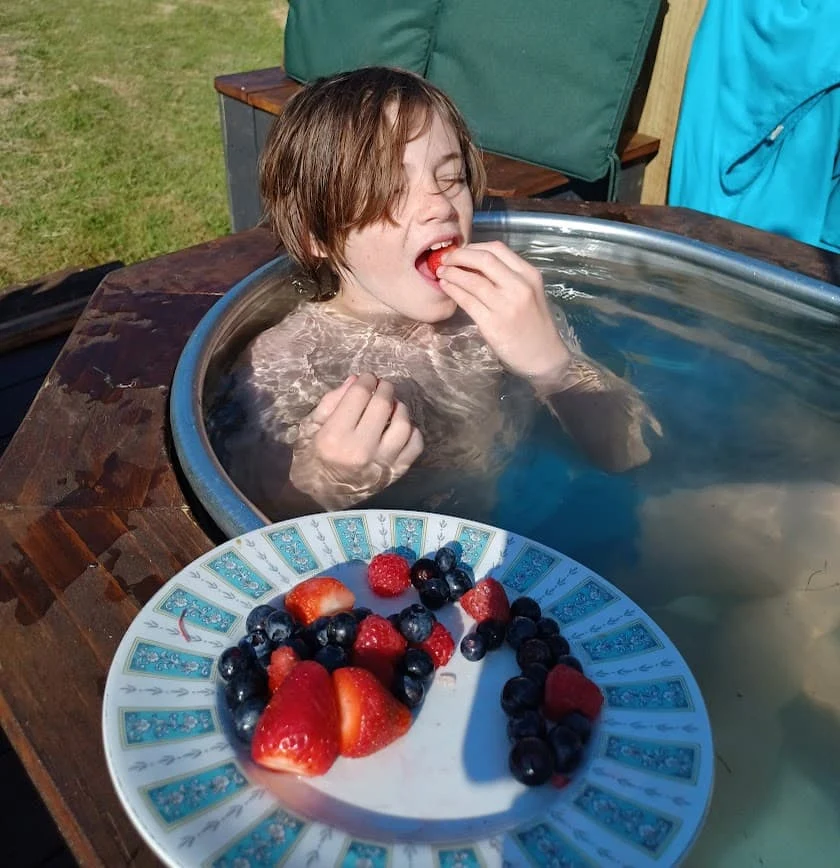
Step outside and you’ll find something truly unique: your private wood-fired hot tub, mounted on its own trailer, nestled privately in the field just for you. Here, evenings unfold slowly under the stars—warm soaks, glowing firelight, and toasted marshmallows shared on the field deck firepit.
The tub is heated using a thermodynamic coil, letting you enjoy the satisfying ritual of lighting the fire, watching the steam rise, and settling in for starlit peace.
Just like the rest of the experience at the cabin and it’s amazing outdoor facilities, the hot-tub is designed for go-slow. Take your time enjoying making and tending the fire to heat it; enjoy the surprise as you stir the water, feeling it steadily heating up….and the first delicious dunk into the hot water. It feels like a treat earned, and one you may well just want to spend hours enjoying fully, under the sun and the stars.
As you’ll see by now, it’s not just about family getaways, the cabin and hot-tub together are perfecr for those who are having romantic off-grid glamping ideas about their next escape. It’s also the perfect natural location for a couples or family digital detox break.
Hot Tub, Deck, Sun-Trap
The Secret Woodland & Hammock Chill Zone
Wander just behind the cabin and you’ll enter The Secret Woodland, a sheltered glade framed by native trees. It’s a private space that feels a little wild, but totally safe—a perfect place to explore, snack, and tell stories.
Here you’ll find:
A campfire cooking area, ideal for BBQ or telling tales over embers
Beautiful seating and decks, positioned for gathering and conversation. You won’t believe these were made from recovered pallets. It was a lot of work, but achieved just the look we wanted: surprising and enchanting.
A serene, tucked-away feel—perfect for daydreamers and explorers
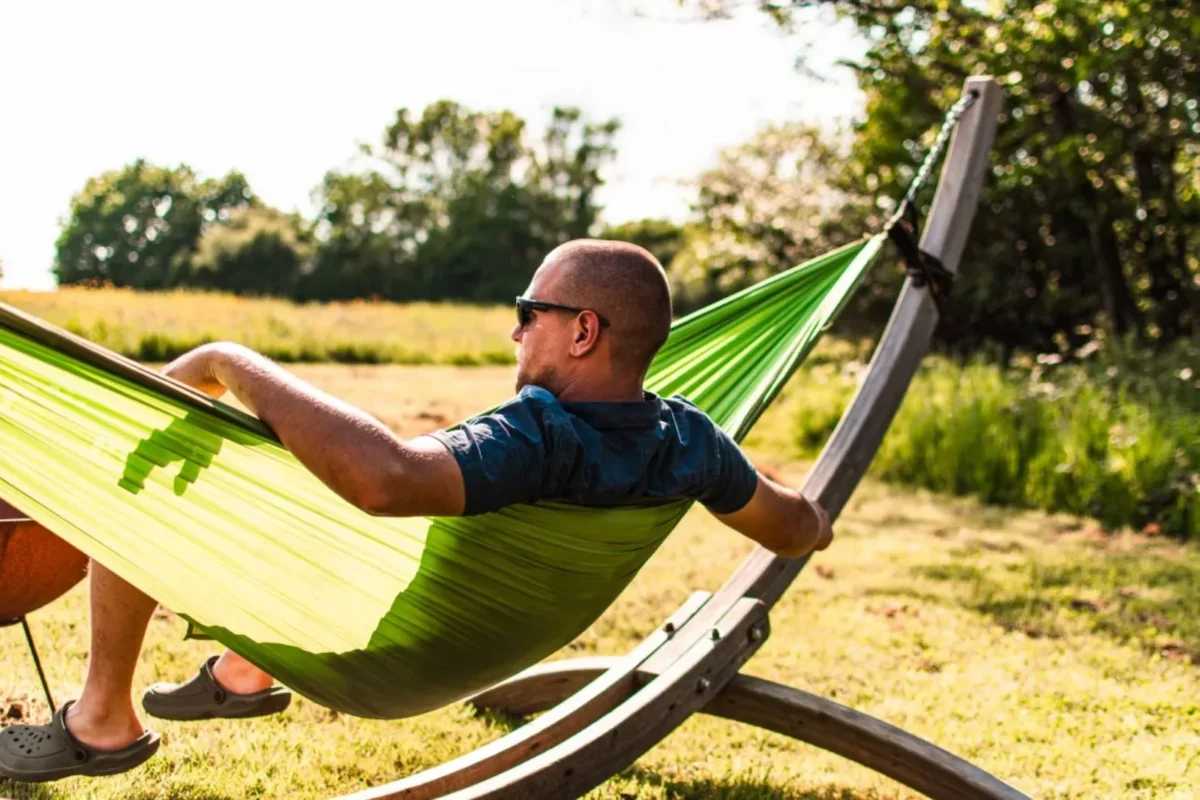
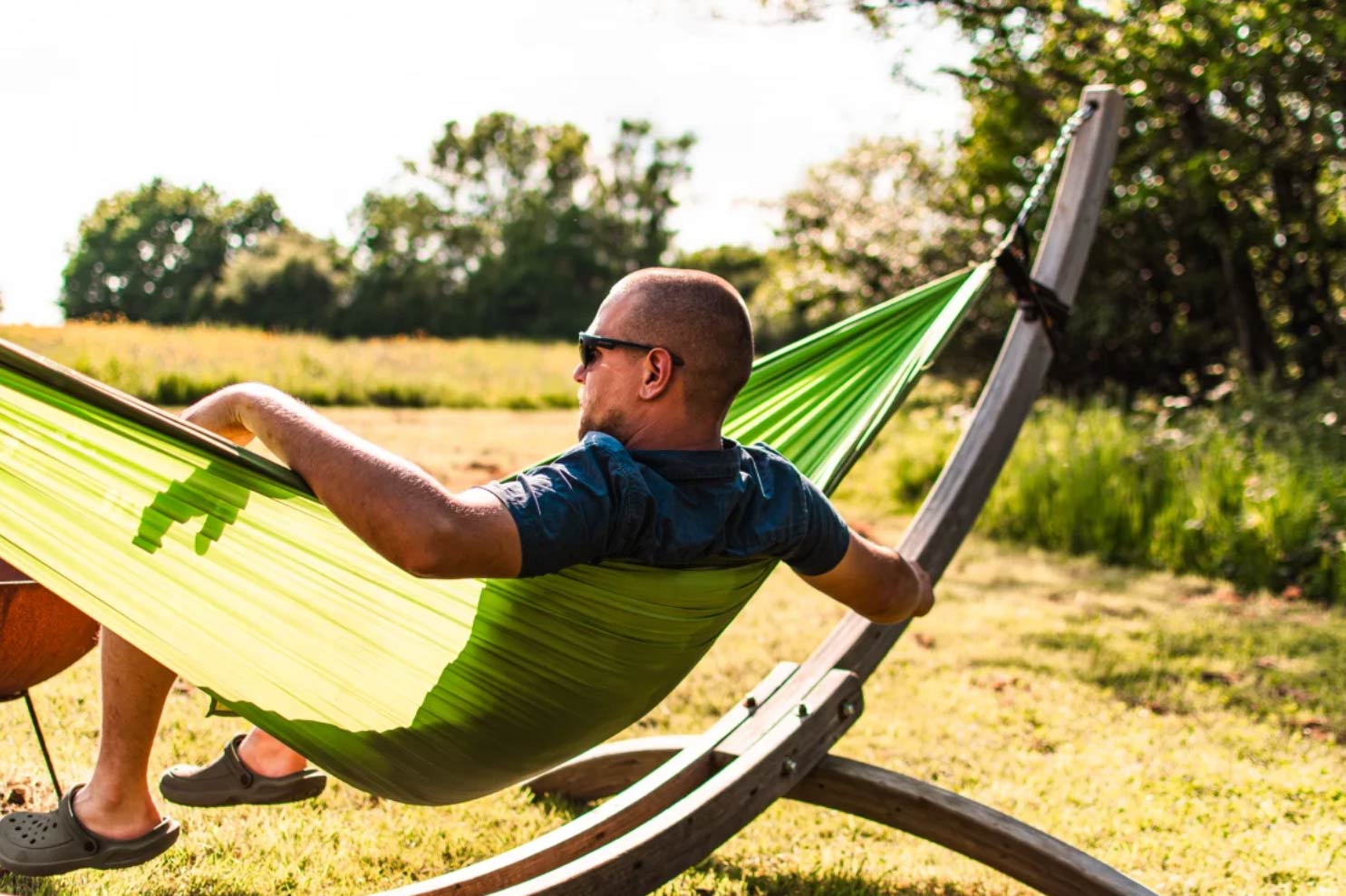
And back out in the meadow? A field-side hammock awaits. Swing lazily after lunch, curl up with a book, or lie with your kids as dusk paints the sky. No agenda, no noise—just time. You’ll find yet another firepit here too. Just in case you want to enjoy the big skies above without the woodland canopy.
The Secret Woodland – all yours!
Thoughtful Design for Family Comfort
This is not camping, and it’s more than glamping—The Vacationist is a true eco-retreat, a cool stay built for real comfort and connection. Inside you’ll find:
A well-equipped kitchen with gas hob, fridge, large sink, and dining/bar space
Infrared underfloor heating for warmth, even on cool mornings
A log-burning stove for cosy evenings
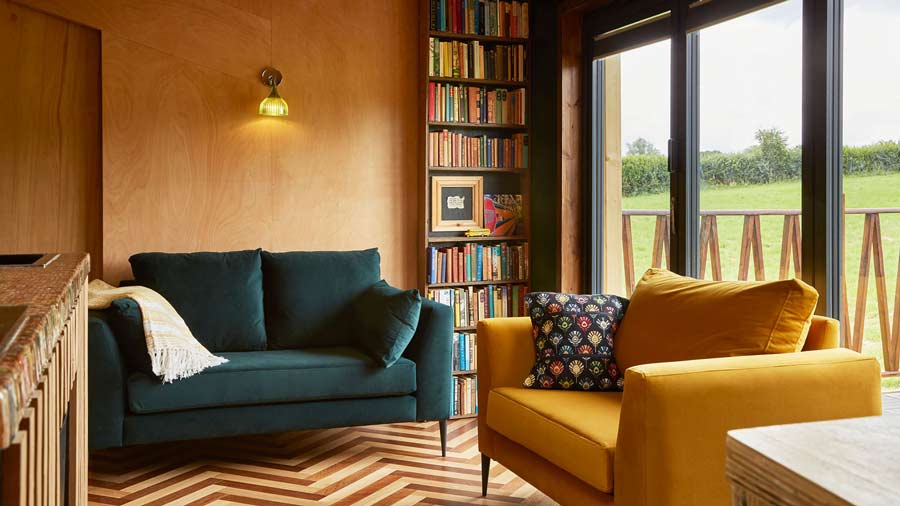
Books, board games, and soft ambient lighting
Power for your essentials, with charging points available
A large sun deck perfect for breakfast or firelit dinners
Every detail is curated to make family life not just easier—but more joyful.
Local Family-Friendly Adventures (If You Want Them)
If you do want to venture out, you’re brilliantly located for family adventures that are fun, wholesome, and easy to reach:
Bluebell Railway – Step back in time with heritage steam trains through the Sussex countryside
Blackberry Farm – a fantastic kid-friendly farm full of activities, animals and ways to while away hours
Lewes– A characterful town with cafés, quirky shops, a historic castle, and riverside walks
South Downs National Park & High Weald AONB – Rolling hills, gentle hikes, picnic spots, and wildlife everywhere
But many families never leave the meadow. And that’s exactly the point.
“Venture out, or don’t! We’ve designed the cabin and the spaces to enjoy in your pricate field – the secret woodland, the hot-tub, the freedom – as a safe place you can just stay in and slow down.”
Evenings Made for Memory-Making
As night falls, the pace slows. Firelight flickers, hot tub steam rises, and the stars come out. Bedtime might mean a story told from the hammock, or a shared laugh in the woodland glade.With no TV, no Wi-Fi, and no digital distractions, you’ll rediscover just how rich the simple things can be. It’s not about doing more—it’s about being more together.
A Retreat They’ll Remember Forever
Long after your stay ends, your children may still talk about the secret door, the firepit dinners, and the time they spent outside from dawn till dusk. And you might remember the rare gift of true stillness, where everyone had space to just be.Whether you’re looking for a weekend reset or a longer school-holiday stay, The Vacationist Eco-Cabin offers a rare kind of break: one that combines sustainability with wonder, and simplicity with style.
What Other Families Say
" This was our most favourite cabin getaway yet. As a family, there was something niche and relaxing for all of us, including my 13 and 9 year olds, who loved the bookcase door and curling up by the log burner. We made S'mores on the open firepit in the cosy private woodland area. The cabin had everything we needed for an escape into nature and being eco-friendly whilst feeling like a real treat. The owner, Guy, checked in with us and made sure everything was as we hoped - and it was so much more. We will absolutely be back. A hidden gem, a stylish cabin, a proper retreat. "
Glamping at Music Festivals in the UK: A Unique Experience
Cabin Glamping at our mini Sussex festival is go!
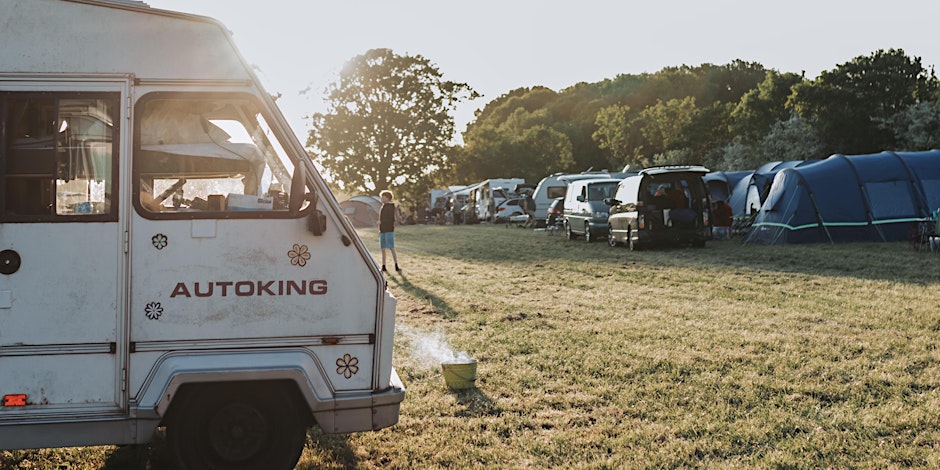
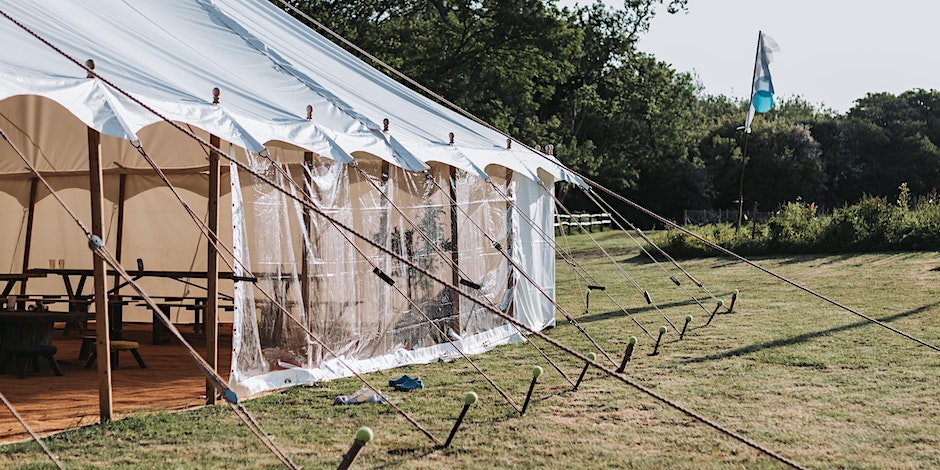
The Vacationist cabin is taking a starring role in the boutique accommodation offering at the new series at mini-festivals at Crockstead Fields this summer. With the first of the family friendly camping weekends kicking off this May, we thought this the right time to wax lyrical about music festivals and glamping. And if you want to join us this year for your own festival glamping experience, take a look here for more details.
For now, let’s explore what glamping at festivals is all about in the UK, where the big crowds go to glamp it up, and where you should go for the big name bands.
A quick guide to festival glamping in the UK
Music festivals in the UK are renowned for their vibrant atmosphere, incredible performances, and the opportunity to immerse oneself in an unforgettable cultural experience. While camping has long been a popular choice for festival accommodation, the concept of glamping has emerged as a luxurious and comfortable alternative for festival-goers who seek a more refined experience amidst the excitement of live music and festivities.
In this quick guide, we will delve into the world of glamping at music festivals in the UK, exploring the benefits, practical tips, and the top destinations for this unique form of accommodation. Whether you’re a seasoned festival enthusiast or a first-time glamping adventurer, this blog post aims to provide you with valuable insights to make the most of your glamping experience at music festivals in the UK.
Understanding Glamping: A Fusion of Glamour and Camping
Glamping, a portmanteau of “glamour” and “camping,” represents an established but still growing trend in the travel and hospitality industry. It offers the perfect blend of luxury and adventure, allowing individuals to connect with nature without sacrificing modern comforts. From spacious bell tents to luxurious yurts and stylish tipis, glamping accommodations come in various forms, each designed to provide a unique and memorable experience.
...the concept of glamping has emerged as a luxurious and comfortable alternative for festival-goers who seek a more refined experience amidst the excitement of live music and festivities.
The Allure of Glamping at Music Festivals
Glamping at music festivals has gained immense popularity due to the numerous benefits it offers. It provides festival-goers with a comfortable retreat amidst the lively and often chaotic festival environment. Here are some compelling reasons why glamping has become a preferred choice for many:
Comfort and Convenience: Glamping accommodations typically include comfortable beds, stylish furnishings, and amenities such as electricity, lighting, and sometimes even en-suite bathrooms. This ensures that festival-goers can relax and rejuvenate in a comfortable setting after a day filled with music and festivities. The best offerings manage to combine these luxuries with an off-grid set up.
Exclusive Facilities: Many glamping sites at music festivals offer exclusive facilities such as dedicated reception areas, pampering zones, and communal spaces where guests can socialize and unwind.
Enhanced Security and Privacy: Glamping areas often come with enhanced security measures, providing peace of mind and a sense of privacy, especially when compared to traditional camping grounds.
Unique Experience: Glamping allows festival-goers to indulge in a unique and memorable experience, creating lasting memories while enjoying the best of both worlds – the thrill of a music festival and the comfort of upscale accommodation.
Top Glamping Destinations for Music Festivals in the UK
The UK is home to a myriad of music festivals, each offering its own distinctive vibe and lineup of artists. Among these, several festivals stand out as prime destinations for glamping enthusiasts. Here are some of the top music festivals in the UK that clearly offer exceptional glamping experiences:
Glastonbury Festival: Renowned for its diverse musical lineup and vibrant atmosphere, Glastonbury Festival offers a range of glamping options, including luxury bell tents and stylish tipis, providing a comfortable and luxurious retreat for festival-goers.
Bestival: This award-winning festival, known for its creative themes and eclectic music, provides an array of glamping accommodations, from boutique camping options to luxurious yurts, ensuring a memorable and comfortable stay for attendees.
Latitude Festival: Set in the stunning countryside of Suffolk, Latitude Festival offers a picturesque setting for glamping enthusiasts. With a variety of glamping choices, including spacious bell tents and cozy cabins, festival-goers can enjoy a relaxing and stylish retreat amidst the festival’s diverse cultural offerings.
Tips for Enjoying Glamping at Music Festivals
To make the most of your glamping experience at music festivals in the UK, consider the following tips:
Book Early: Glamping accommodations at popular festivals tend to sell out quickly. Booking early ensures that you have a wider selection of options and can secure the best location within the glamping area.
Pack Wisely: While glamping offers comfort and convenience, it’s essential to pack strategically. Consider bringing earplugs, a portable charger, and any additional items that can enhance your overall festival experience.
Embrace the Community: Glamping areas often foster a sense of community among attendees. Take the opportunity to mingle with fellow glampers, share experiences, and immerse yourself in the unique camaraderie of festival life.
Respect the Environment: Glamping is about enjoying nature responsibly. Be mindful of waste management, conserve energy, and adhere to the festival’s environmental guidelines to minimize your ecological footprint.
Explore the Festival: While the allure of glamping is undeniable, don’t forget to immerse yourself in the festival experience. Discover new artists, indulge in local cuisine, and partake in the various activities that the festival has to offer.
Only you can answer that! But there is no doubt that glamping at music festivals in the UK offers a delightful fusion of luxury and adventure, providing festival-goers with an exceptional way to experience the excitement of live music while indulging in comfortable and stylish accommodations. Whether you’re drawn to the eclectic energy of Glastonbury, the creative themes of Bestival, or the picturesque landscapes of Latitude, glamping at these renowned festivals promises an unforgettable and immersive experience. By embracing the tips and insights provided in this guide, you can elevate your glamping adventure and create lasting memories amidst the electrifying ambiance of music festivals in the UK.
Stay at the Vacationist log cabin for our Summer 2024 Festival Experiences
Tours and tastings at internationally acclaimed vineyards not far from the cabin
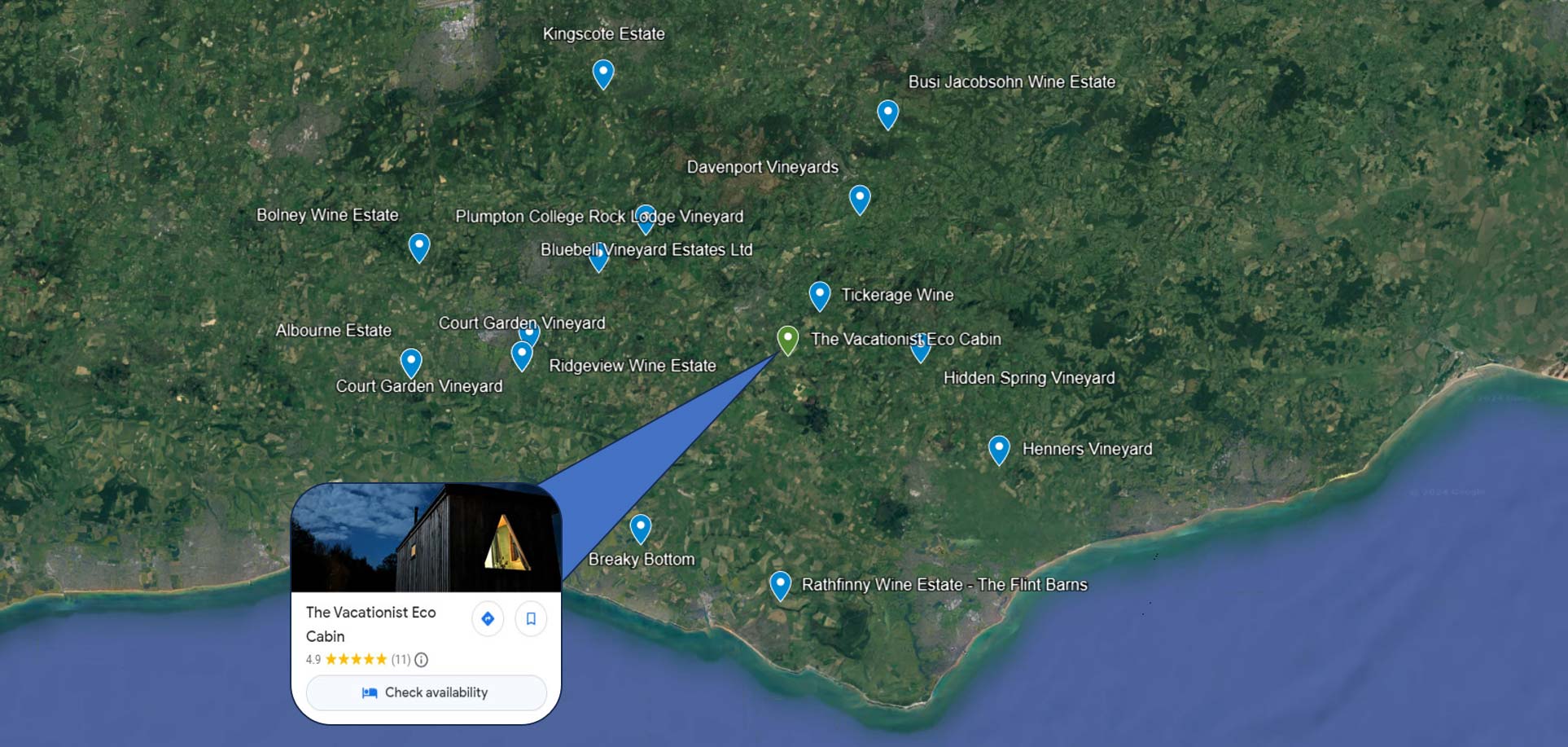
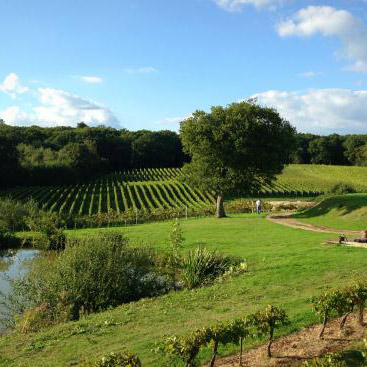
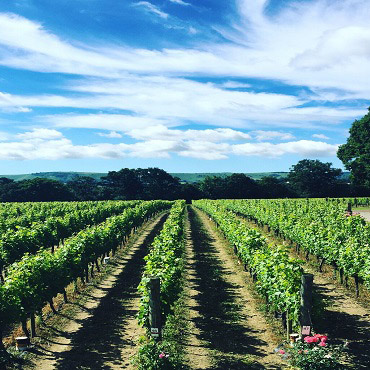
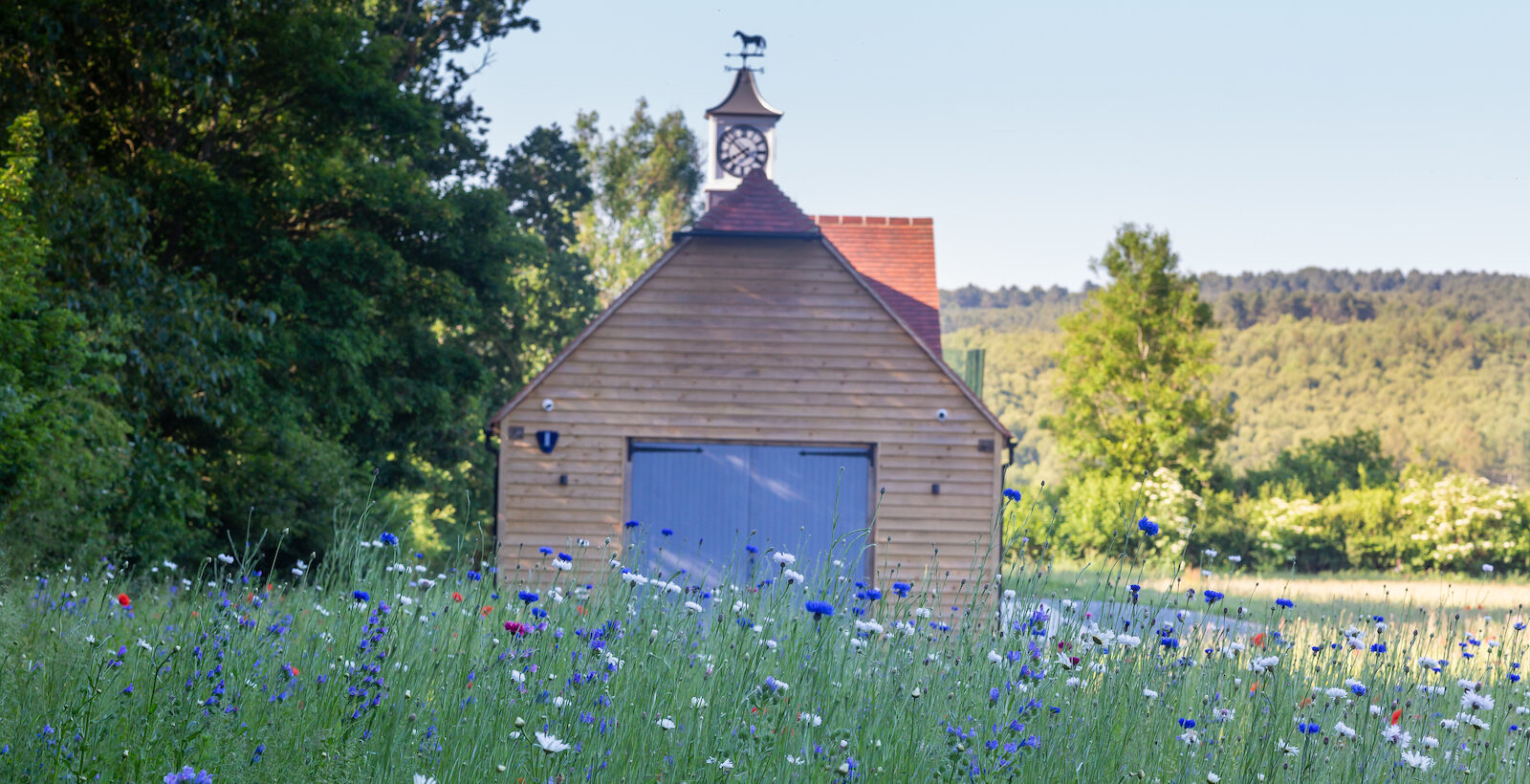
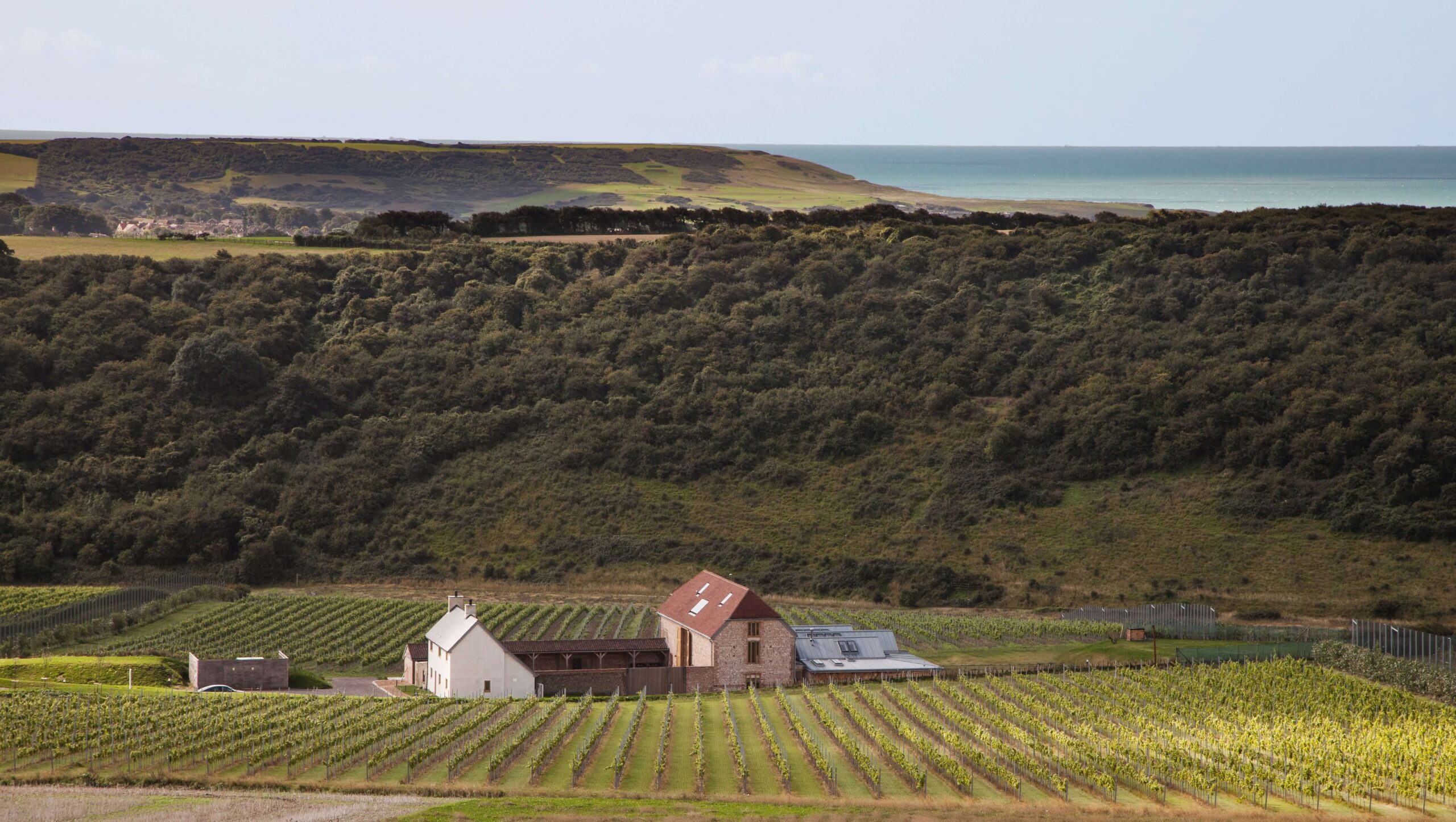
Exploring the Sussex Wine Region, from the cabin.
You may well have heard of Ridgeview, Nyetimber or Bolney Wine Estate – they have put Sussex on the international wine map – but there are many other vineyards in the area who are taking advantage of the incredible terroir and climate to produce stunning wines.
The good news for our guests is that many of these wonderful vineyards are right on our doorstep, or just a short drive away. They are often open year-round for visitors interested in tours and tastings. A lot of them have restaurants too – fine wine, fine food and fine company sounds like the perfect way to spend a day!
The (not so) secret behind their success of Sussex’s wine is the terroir and climate. The vines thrive on the diverse mix of clay, sand and limestone and benefit from the relatively mild weather and low rainfall. The proximity to the sea means less extreme temperatures, so the grapes are kept warm and ripen slowly, absorbing all those minerals to develop the most exceptional flavours. The perfect climate has lead to a profusion of vineyards – just check out this interactive map!
With land that is very similar to Champagne, many vintners opt to produce grape varieties like Chardonnay, Pinot Noir, and Pinot Meunier, each of which make excellent sparkling wine but also allow for some rather lovely stills too.. We now have several vineyards of international acclaim with sparkling wine that rivals that of the French. Sussex Modern often writes in more detail about each vineyard and even lets you know who needs help with the picking! For those interested in just sampling the wines though, many of the local vineyards offer tours and tastings year round.
We now have several vineyards of international acclaim with sparkling wine that rivals that of the French
Exploring the Sussex Wine Region
You may well have heard of Ridgeview, Nyetimber or Bolney Wine Estate – they have put Sussex on the international wine map – but there are many other vineyards in the area who are taking advantage of the incredible terroir and climate to produce stunning wines.
The good news for our guests is that many of these wonderful vineyards are right on our doorstep and are open year-round for visitors interested in tours and tastings. A lot of them have restaurants too – fine wine, fine food and fine company sounds like the perfect way to spend a day!
Tickerage Wine – 6 minutes from the cabin!
Tickerage is our closest vineyard – you could even walk it. It’s a lovely, family-owned vineyard that offers immersive tours that include a tasting of three of their award winning wines.
Tickerage is open year-round but you can’t drop in. They do offer public tours though and you can get in touch about private tours. Get in touch with them online.
Renowned for its scenic vineyards and historic setting, Kingscote have a cellar door bar, café & kitchen, wine shop and an impressive estate and vineyard which you can tour, adding on lunch or a cream tea if you so wish! Book online to secure your space.
Busi Jacobsohn is a boutique winery in Sussex which focuses on producing limited quantities of high-quality wines. They offer few public tours but if you get in touch in advance, you may be able to visit their cellar door or have a private wine tasting.
Busi Jacobsohn Wine requests that you contact them before visiting. They may be able to open their cellar door and could possibly even book in a private tour.
Bluebell Vineyard – 20 mins from the cabin
Bluebell has gained recognition for its classic English sparkling wines. Their tours commonly include guided walks through the vineyards, insights into their winemaking techniques, and conclude with tastings of their diverse sparkling wines. Tours and tastings can be booked online or you can just pop along and take a wander through the vineyard and woodland trail and enjoy the spectacular views of the vineyard and waters from the terraced seating area.
One of the pioneering names in English sparkling wine, Ridgeview hosts lots of different tours and tastings, including pairings with cheese and themed tastings, all of which you can book online.
Ridgeview has a shop which is open all week but the restaurant is only Thursday – Sunday afternoons
Rathfinney
A significant player in the English wine scene, Rathfinney offers seasonal vineyard tours, which you can book online, providing insights into their vineyard management, winemaking processes, and sustainable viticulture practices. They also have a restaurant onsite.
Rathfinney is open all week but tours are on Tuesday – Saturday.
A family-run establishment which focuses on producing premium still and sparkling wines. They give a tasting without prior booking but if you want a tour, you can book a group one online or contact them for a private one.
This article tackles an industry that has hugely detrimental effect on the environment: fashion.
The scary stats behind fast fashion
The fashion industry is responsible for an estimated 10% of humanity’s carbon emissions and has the fifth largest carbon footprint of any industry, according to the World Economic Forum.
So what are we doing about it? Very little it seems.
We demandcheap clothes, so companies use factories in developing countries who regularly dump harmful chemicals in waterways. Around half a million tons of microfibre, which is the equivalent of three million barrels of oil, is being dumped into the ocean every year.
We keeppurchasing new stuff, and that requires some 93 billion cubic metres of water annually (which is enough to meet the needs of five million people)
Wediscard quickly – according to the Ellen Macarthur Foundation, every second, the equivalent of a rubbish truck load of clothes is burnt or buried in landfill.
A good pair of jeans can be recycled. Read more about how fashion designers are working together to redesign jeans to make them better for the environment.
Denim for life
At the Vacationist Eco Cabin we wanted to tackle fabric waste as part of our build. We chose to focus on denim because for decades jeans have been a staple of the wardrobe. Everybody has a pair.
The problem with jeans is that most people have not just one pair, but many pairs. Jeans from our younger days, which we can now only get on if we lie down and breathe in; jeans from a different fashion period which don’t quite work today; jeans with an annoying hole in the knee that won’t stay sewn up…. jeans, jeans, jeans.
We decided to rethink how we used some of our old jeans – creating soft furnishings for the cabin instead of storing them in our wardrobe for no good reason.
Rethinking denim – making cushions
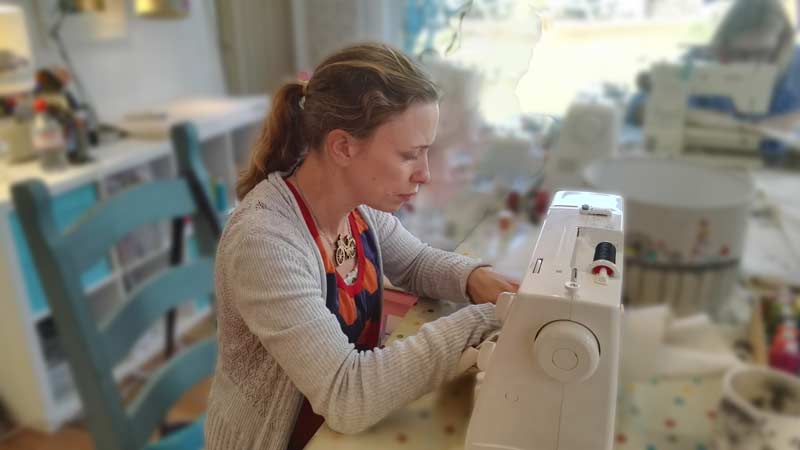
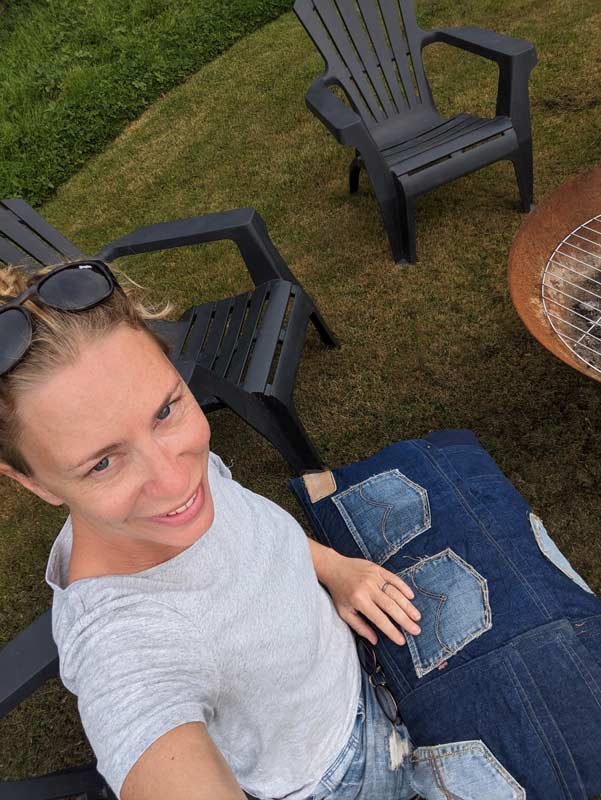
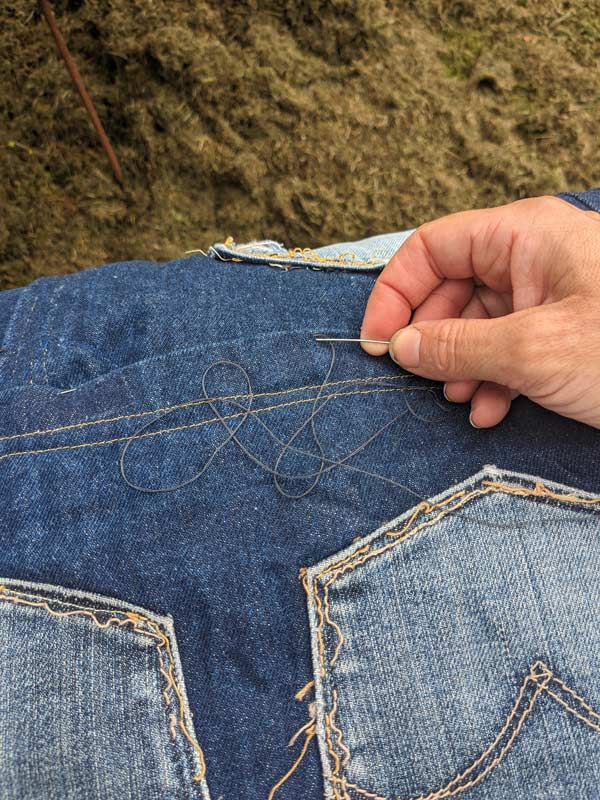
I cut out the useable parts of our old jeans as well as some of the embellishments. Pockets and rivets make for great details. The scissors also came out on a pile of old tops and dresses that were misshaped, stained or damaged. None of them would have been wearable so there was no point donating them to charity.
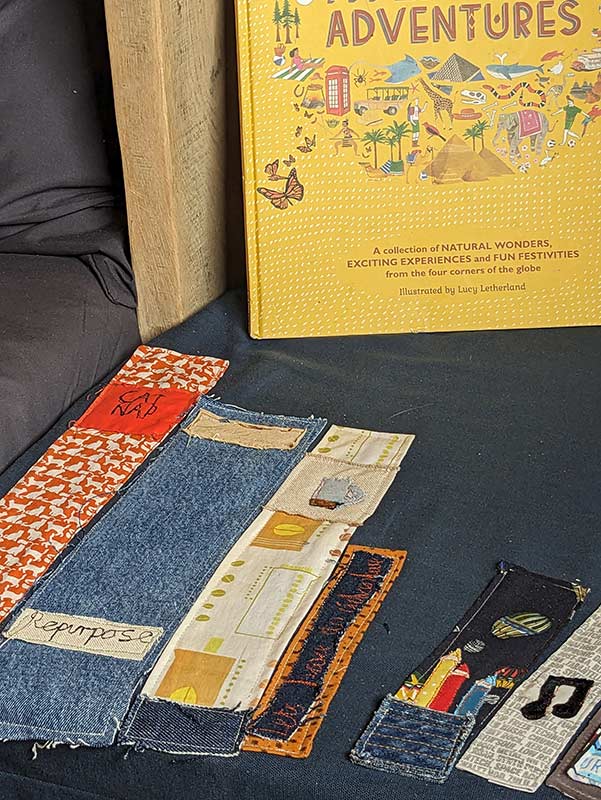
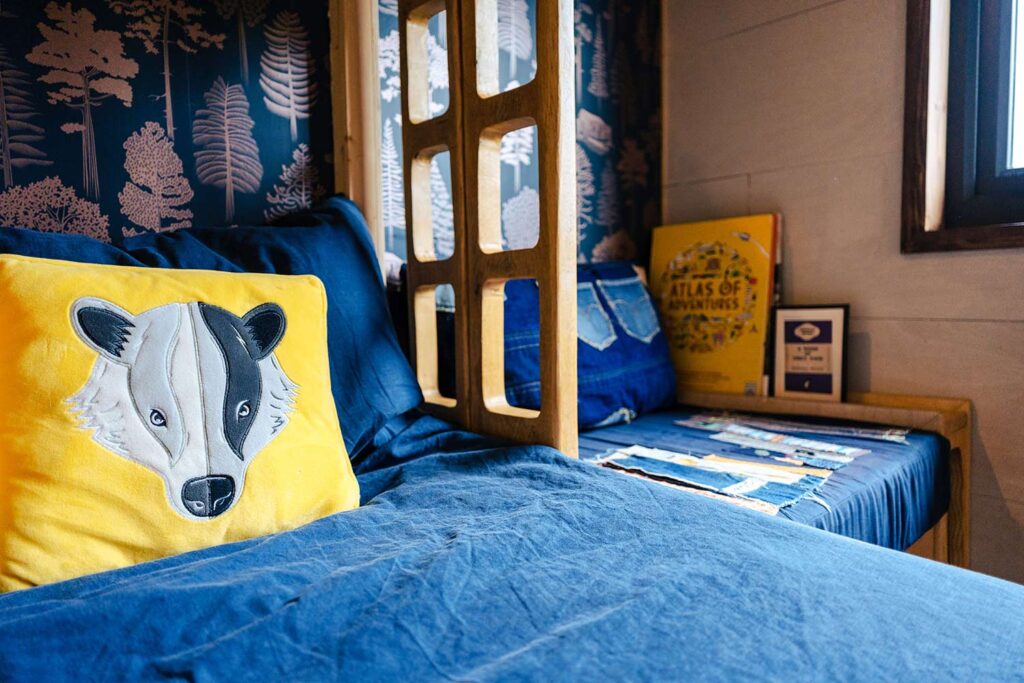
Using both a sewing machine and hand sewing, I created cushions for the children’s room in the cabin that fitted with our book theme. I also made a lovely denim pocket cushion for the sofa.
Can we say we are carbon neutral? It’s tricky to find a calculator or website that can confirm that for us, but what we do know is that to measure it, we need to think about two things:
Embodied carbon – connected with the build
Operational carbon – connected with the use.
Solar power
Solar panels need to be installed for just three years before the overall carbon footprint drops into the negatives. At this point, the panels will be preventing more emissions than it took to create them.
We’ve hooked up the solar to our infrared heating and water heater so that if you have excess energy it can be diverted to where you need it most. Nothing is wasted.
That means both the embodied and operational carbon are on target to be zero.
Solid foundations
Concrete is responsible for 4-8% of the world’s carbon dioxide (CO2) emissions – second only to water, it is the most widely used substance on Earth after water.
We chose to repurpose an old trailer for our base which means we don’t need foundations. We also gave new life to a piece of old machinery that serves no functional purpose anymore. We look at that as a win for both operational and embodied carbon.
Working with wood
Wood is renewable, has a lower thermal conductivity than brick and also stores more carbon than the manufacturing process uses, making it a carbon neutral material.
By sourcing wood certified by the Forest Stewardship Council (FSC), who typically plant two to three trees for every tree felled, we ensure growth in both forest cover and CO2-hungry young trees.
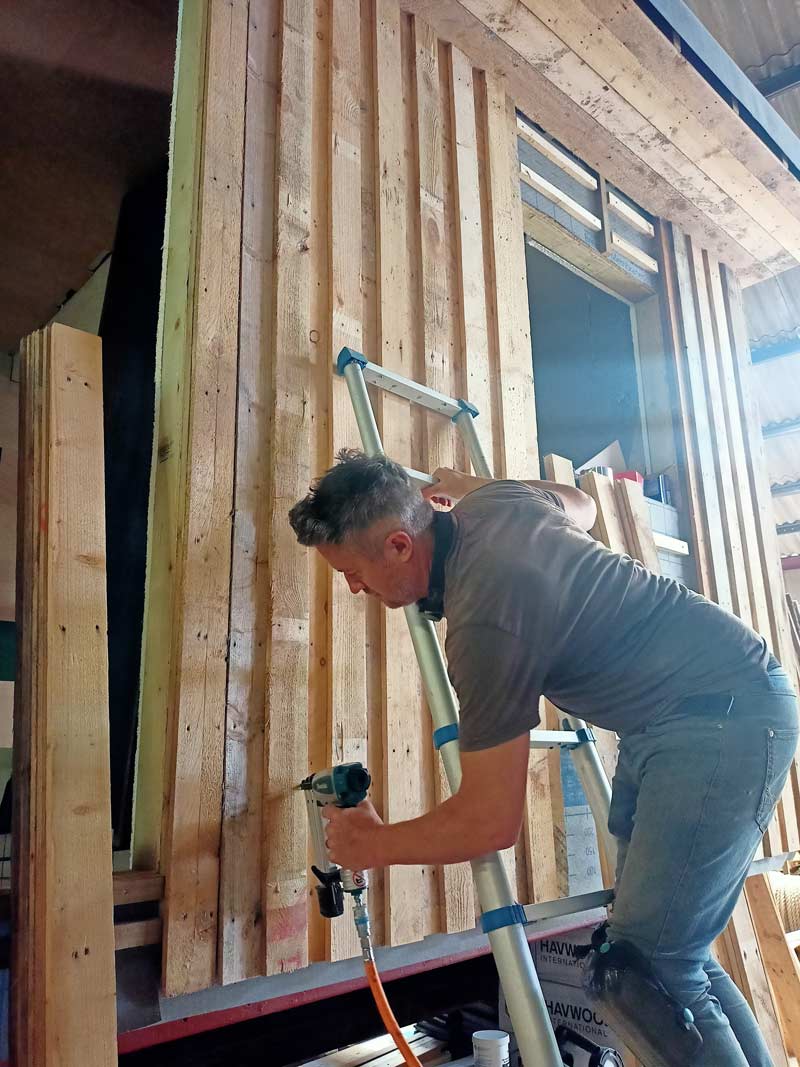
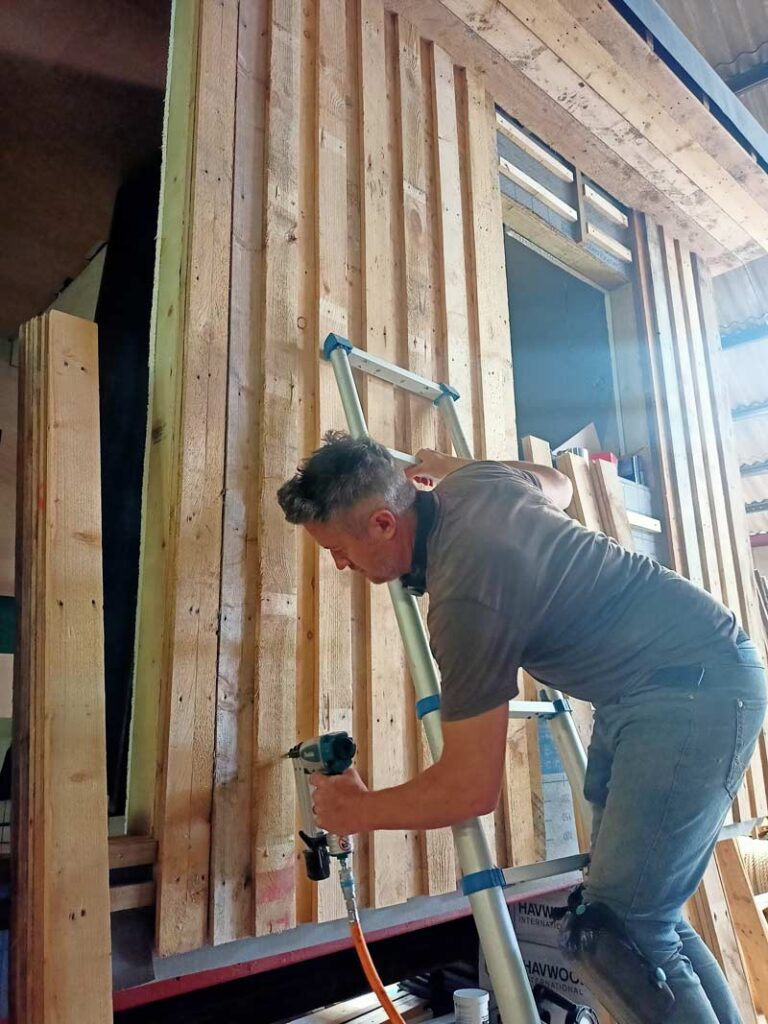
We chose to use repurposed wood to clad our entire cabin. Saving carbon and saving trees.
Heating with gas
Heating was an environmental compromise for us. We cannot make it completely carbon-neutral because we have to use fuel to heat the cabin and the water supply for showers. This is a luxury cabin after all!
We chose to use propane. Whilst this is sourced from crude oil, so is not as environmentally friendly as solar, wind, geothermal or hydro sources, it does have less of an adverse effect on the natural world than gas or wood.
To balance our use of propane we have a tankless water heater that is one of the most environmentally friendly options available for off-grid set ups. It provides hot water only as it is needed.
If we look at the total footprint of our propane, its 0.19. That works out at 0.001 tonnes of CO2e per stay. We make sure that we add it up over the course of a year and reinvest into schemes to support carbon-saving initiatives.
Protecting water
As water scarcity and drought conditions persist globally, we are all being encouraged to think of reusing of greywater. We need to use our resources wisely.
Our compost toilet saves a massive 4-13 litres of water in a regular flush toilet. It does this by separating the solids and liquids, which removes the odours and means we don’t need a flush.
Composting the solids kills harmful pathogens but the nutrients remain. The result is an organic compost that feeds the soil as well as the plants. In the past this ‘night soil’ was highly coveted. These days we don’t like to think about what happens to our poo, but perhaps we should.
At the same time, we are saving carbon by removing the need for treatment. The carbon cost of potable water treatment is much higher than it need be, because we treat much more water to potable standards than we need to.
With no black water in our system (from the toilet) we can also use our greywater to irrigate the fields. We have built a filtration system that clears the debris and allows us to support the biodiversity around us.
Eco heating
Heating that uses hot air is highly inefficient. As infrared heats the material in the room, rather than the air, it uses less energy. It also has less heat loss. We have installed it throughout the cabin to keep your feet warm in winter.
Our heating aims extended to our log burner too. We love the feel of a cosy fire but burning wood has its issues. We chose a bioethanol rather to balance the feel with a cleaner fuel. Bioethanol is a renewable energy source produced by a sugar fermentation process. There’s no smoke and no carbon released. Our burner adds nothing to the environment and takes nothing from it either. What it does do is make for a very cosy living space!
When you couple all that with our double-glazing and sheep’s wool insulation, we have an efficient space with no carbon impact.
How we built a secret cabin bookcase door from unwanted books
Rethinking waste part 2: books
In Rethinking Waste: pencils we talked about what happens to day-to-day items when you have a surplus. All too often we assume can recycle something when in actual fact, we can’t.
This article tackles something a little trickier. Books. What happens when we no longer want the literature that has adorned our bookshelves for years?
For most people, the first option is the charity shop. But this isn’t always the solution you think it is.
And what about recycling? Books are paper…. or are they?
The story behind the secret cabin door
When we designed the cabin, we spoke to our kids about how we could make the children’s bunk room cool. They immediately knew – a secret bookcase door.
Through FB marketplace I came across a lady whose father-in-law was going into care. He had collected books his whole life and had a huge bookcase of ex-library books and old hardback history and travel books that she had no idea what to do with. We collected them and started working on our design.
And then we hit a snag..
Books are heavy and the door was huge. In order to turn the kid’s vision into reality, we would have to reduce the weight and size of the project and this could only be achieved by chopping up the books to make them two-thirds of the size.
That felt very wrong. People have strong feelings about books. All those words that somebody wrote and all that time they spent creating their masterpiece. And the impact: a book has the power to inspire you, give you clarity, even change or challenge your assumptions about life. Chopping them up felt disrespectful.
Aware that we would have to abandon our plan for a secret bookcase, I spent a day trying to get rid of all the books I had accumulated. Some of them had beautiful covers and looked to have value, so I catalogued, photographed and researched the collection before sending the images to booksellers who appeared to deal in the relevant areas.
I was told categorically by all of them that they had absolutely no value and were not wanted. Send them to a charity shop.
I contacted charity shops, but with the current trend to de-clutter, and the rise of e-readers replacing physical books, they didn’t want all of my books. Some may have been accepted, but I had hundreds. If you think about it, it’s obvious. Storage is at a premium and charity shops only really want stock they can sell. And what sells is not always what is most popular. The Daily Telegraph reported that after the initial buzz about Fifty Shades of Grey, Cancer Research UK found that for every donated book they sold, “they (would) get two donations in its place… People are offloading them now in droves …its becoming a paper mountain”. They stopped accepting them.
There are of course online booksellers. Ziffit, for example. takes books. You can scan them in and may even make some money from Ziffit. Be aware they only want “good, readable condition” though. If they are annotated, damaged, missing a dust jacket, ex-rental or missing supplements, they get sent off for recycling. The same applies for webuybooks.
Recycle now says “Books cannot usually be recycled at kerbside along with other paper recycling because of the glue that’s used to bind them.”
So if charity shops don’t want them, Ziffit won’t take them and they can’t be recycled, what next?
OPEN THE SECRET BOOKCASE DOOR, HUNKER DOWN, READ A BOOK – FIND OUT ABOUT
The Vacationist has been converted with the environment in mind. Lovingly hand-crafted by carpenters and creatives searching to reduce the carbon impact of holidays, the cabin is the perfect balance of comfort, escapism and eco- solutions.
Nestled in a private meadow, The Vacationist offers access to hiking, biking, spas, kids activities and lovely pubs! It is also next to Crockstead Fields – a festival and wedding site for those who are attending an event and don’t fancy roughing it in a tent!
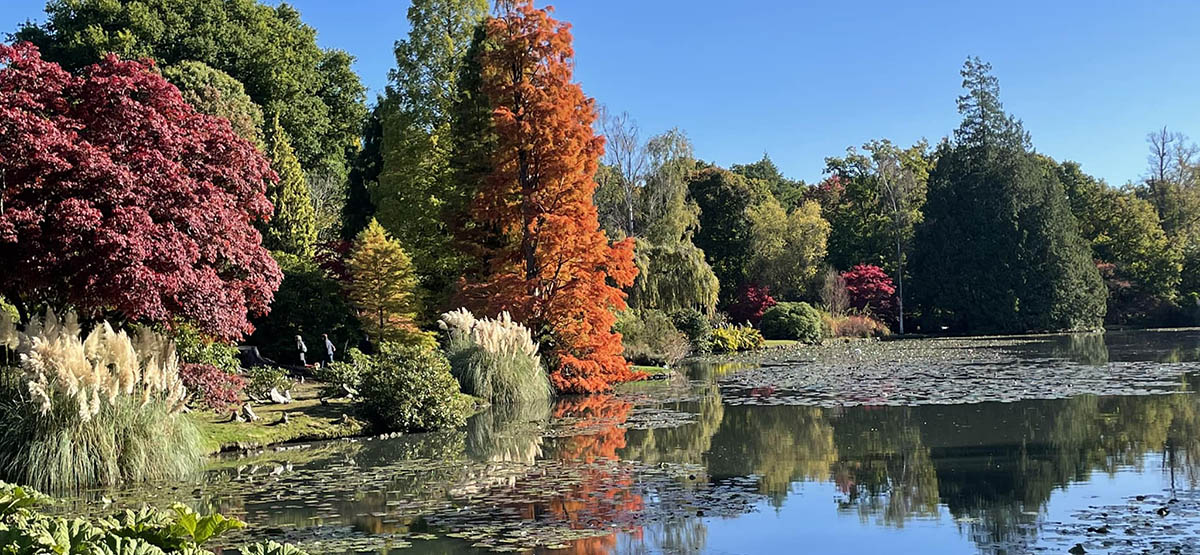
Hike or bike the hills and cliffs; enjoy the ambience, food and drink of the local villages; immerse yourself in seaside fun; explore acres of Grade I listed landscaped garden and lakes at Sheffield Park or get your adrenaline fix at Branching Out Adventures.
I started to wonder if perhaps we should rethink what a book’s purpose is. We are long gone from the days in which only one manuscript was written – when books really were sacred. If I took what I wrote above – about inspiration and challenging assumptions – I realised that we could keep the power of books alive by rethinking the way in which we used them.
Our bookcase idea was created by our kids because we have brought them up to read books. They were engaged and inspired by stories of secret bookcases and hidden dens. I had told them it wasn’t possible because we couldn’t cut up books, but now I realised that there was really no place for old books to go to die and perhaps they might actual fulfil their purpose by adorning our door in a more slimline form.
Creating our secret bookshelf door
I won’t lie – it felt very wrong bringing the saw down.
We took the books that were damaged or that we believed would not sell and methodically cut them into two-third versions of their former selves. We glued them into position (for safety).
The only book we bought during the process was “The Secret Door”… we wanted something that might grab a child’s attention and this was the perfect clue.
In place, the bookshelf looks amazing. But what is even better is the reaction we have had from young people. Their eyes light up with magic when they discover the secret.
When they go inside, they find books on adventuring and stories of the world, activity books and tales of how we can help the planet. They curl up and dive right into them. Our literary door has set the tone to a weekend of escapism, inspiration and creativity.
Creating an epoxy kitchen countertop from unwanted pencils
Rethinking waste
What happens to old things when you don’t want them any more? It’s all too easy to drop them off at a charity shop or put them in the recycling box and forget all about them. But what really happens to our waste?
We tried to think about this during the build, not just to save money and waste in general, but also to pose questions to our guests about what happens to the things they throw away. What do we do with the things that cannot be reused or repurposed. Where do the materials we use every day come from, where do they go when we are finished with them and is there a way we reuse them by rethinking their purpose?
Reduce, reuse, recycle… it’s all good stuff, but we want to add a new R for RETHINK.
Stay at the cabin to see our Epoxy Pencil Kitchen countertop in its full glory, and much more! See the cabin in full here.
It takes 82,000 trees to support the global demand for pencils
According to the Guardian, the pencil was once judged by Forbes magazine to be the fourth most important tool in human history… after the knife, the abacus and the compass. 14 billion are made per year. That’s a phenomenal amount of product.
But are they all in use? If you are anything like us, you have probably accrued hundreds over the years. Kid’s parties, pizza restaurants, corporate giveaways, pocket-money trips to Smiggle to buy something that smells like either tangerine or melon…. One pencil case has no doubt morphed into several, it’s become a box, it’s become a whole drawer.
So what happens to those pencils you no longer need or want?
Recycling pencils
Pencils are made of wood with a graphite, or coloured core (which is made by combining wax and/or oil, water, bonding agents, and pigments). They sometimes have a metal ferrule with a rubber on the end, and typically they are painted on the outside.
All of those things are recyclable, but like many products, the fact they are combined is problematic. They need to be stripped down to their component parts to effectively recycle them. Not only is that time-consuming, it only works if they are made from all-natural materials.
Pencils are often made cheaply with poor product. They might come wrapped in sparkly plastic, have glue mixed in with the clay or use synthetic rubber. That effectively makes them unrecyclable and curbside recycling won’t take them.
What about the alternatives? Well there isn’t really any. In the UK Terracycle offer pencil recycling, but they only take mechanical pencils. The same goes for Rymans.
If you want to use your old pencils, you need to RETHINK AND GET CREATIVE!
Creating an epoxy kitchen worktop
When we built our first project – Skoolie Stays – we created a kitchen counter out of old pennies and halfpennies set into epoxy. It looked incredible and so we decided that we’d tackle pencil waste in the same way.
We put a shout out on our local school Facebook Page and began a collection for people’s old pencils. They came in all shapes and sizes.
Each pencil was chopped down into a 1cm nub before being glued to a wooden base. It took several days and 2014 pencils to cover the entire piece. We then poured epoxy in several layers, sanding back each time to expose the pencils, before the final pour that created a glossy finish.